
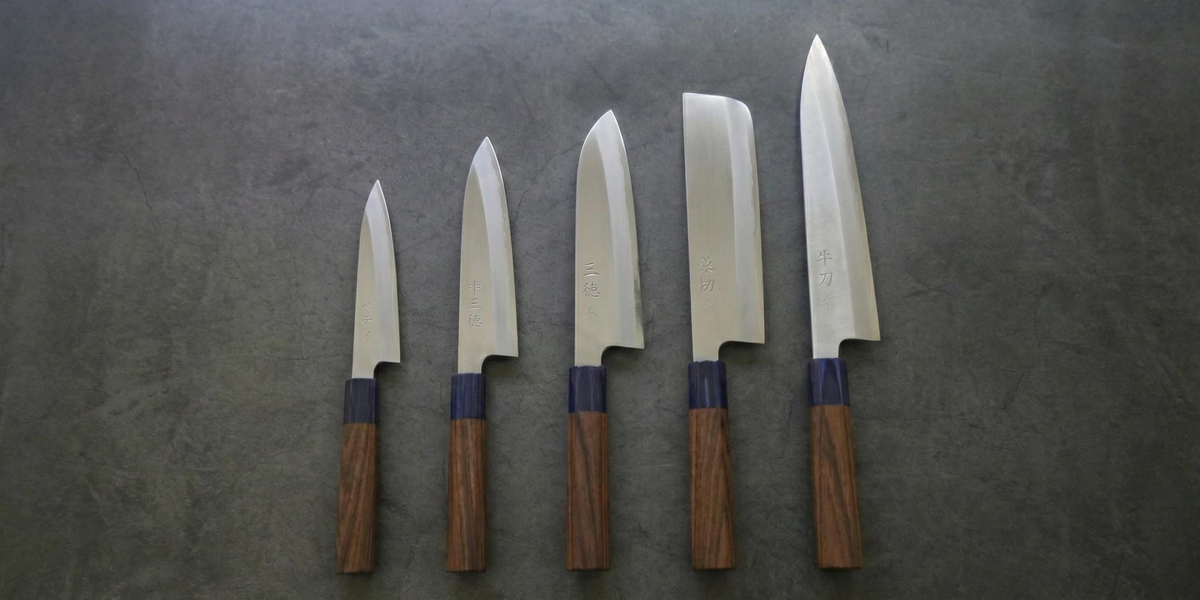
In This Guide
- 1 Three Knives, One Choice: Santoku, Gyuto & Petty Why 99% of home cooks only need one of these three — and how to pick the right one for how you cook.
- 2 Steel: Keep It Simple The two types that matter, the one to skip for your first knife, and the brands worth buying by budget.
- 3 Care, Sharpening & What Makes These Knives Different Three rules that keep a Japanese knife sharp for decades — and why the edge angle changes everything.
Why Japanese Knives Feel Different
Japanese knives aren't just sharper Western knives. They're built around a different idea: the perfect cut.
In Japanese cuisine, many ingredients are eaten raw. Sashimi masters talk about a cut that severs cell walls cleanly without crushing them — because a crushed cell releases its liquid, which changes the texture and dilutes the flavor. That's why Japanese knives have thinner blades, harder steel, and a more acute edge angle (typically 15° per side vs. 20–25° for Western knives). The result: cutting that feels less like effort and more like separation.
神は細部に宿る — "God Dwells in the Details"
Japanese knife makers hold that a blade is not merely a tool — it's an instrument that respects the ingredient and honors a tradition refined over centuries. This is why a well-made Japanese knife feels different the moment it enters your hand.
Three Knives, One Choice: Santoku, Gyuto & Petty
Japanese professional kitchens use dozens of specialized knives. For home cooks, three cover virtually every task. Start with one.
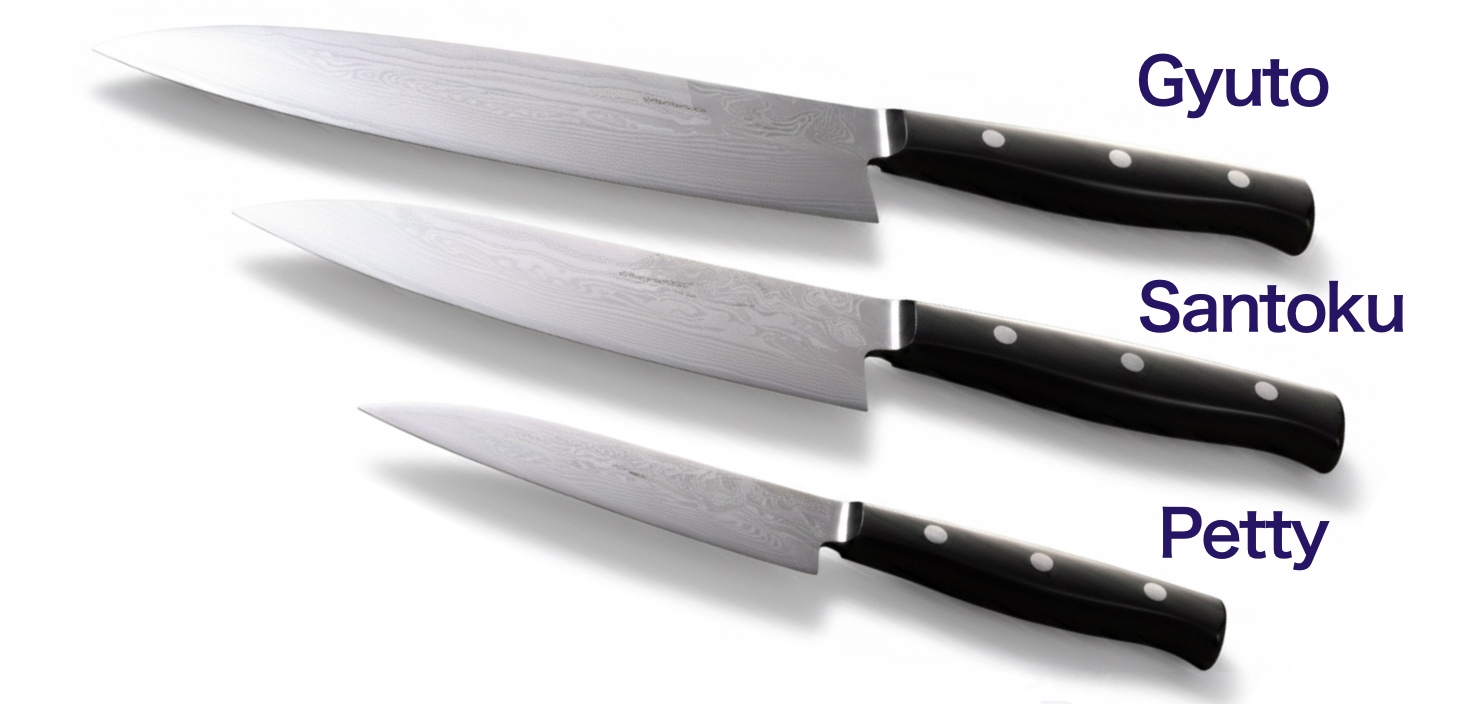
Three essential Japanese knife styles: Gyuto (top) for professional use, Santoku (middle) for all-purpose home cooking, and Petty (bottom) for detail work.
1. Santoku (三徳) — The All-Rounder
"Three virtues" (三つの徳): meat, fish, and vegetables. Japan's all-purpose home knife. Shorter and flatter than a chef's knife, which makes it more approachable — but the hard steel means a noticeably sharper edge from day one.
Best for: Daily cooking, beginners, smaller cutting boards.
Size sweet spot: 170mm (6.7").
2. Gyuto (牛刀) — The Professional's Choice
The Japanese take on a Western chef's knife: longer, thinner, harder. Its curved blade works with the rock-chop technique most Western cooks are used to, while delivering Japanese-level precision.
Best for: Larger proteins, serious home cooks, Western cooking techniques.
Size: 210mm (8") if you're new to Japanese knives; 240mm (9.5") once experienced.
3. Petty Knife (ペティ) — Your Second Knife
Small, precise, and indispensable for everything a large knife can't do: peeling, segmenting citrus, preparing herbs, detail work. Don't make this your first knife — but plan to add one within six months.
Best for: Peeling, intricate prep, quick tasks.
Size: 120–150mm (4.5–6").
| Knife Type | Best First Knife? | Primary Use | Blade Length |
|---|---|---|---|
| Santoku | ✓ Best for beginners | All-purpose daily cooking | 165–180mm |
| Gyuto | Yes — if you cook Western-style | Large proteins, vegetables | 210–240mm |
| Petty | No — ideal as second knife | Peeling, detail work | 120–150mm |
Size: The Japanese Perspective
Japanese knife sizing follows one principle: the knife should match your cutting board, not your hand. Balance point and weight distribution matter far more than raw length. As one Japanese cook put it: "I'm a small woman with small hands. I use a 240mm gyuto daily. The balance makes it feel like an extension of my arm."
Steel: Keep It Simple
Japanese knives are harder than Western knives — that hardness is what enables the acute edge angles that make them feel remarkable. But harder steel is also more brittle. The trade-off is real, and choosing wisely means understanding it.
Stainless Steel — Start Here
Pros: Rust-resistant, low maintenance, forgiving of the occasional imperfect care routine.
Popular alloys: VG-10, VG-MAX, Molybdenum Vanadium (all achieve 60–61 HRC hardness).
Brands: Shun, Global, Tojiro.
This is the right choice for your first Japanese knife. The maintenance is easy; the performance is excellent.
Carbon Steel — Skip for Now
Pros: Keener edge, holds it longer.
Cons: Rusts within hours if not dried immediately. Needs regular oiling. A more demanding relationship.
Verdict: A beautiful choice for your second or third knife, once you've built the care habits. Not your first.
Budget Guide
Entry ($60–$100): Tojiro DP Series (best value, made in Tsubame-Sanjo), Mac Professional (lightweight, restaurant-quality).
Mid-range ($100–$200): Shun Classic (VG-MAX core, Damascus cladding), Global (iconic design, all-stainless, easy maintenance).
Premium ($200+): Miyabi Artisan (hand-honed, 63 HRC, SG2 steel), Takamura (artisan workshop, carbon-steel performance in stainless).
Care, Sharpening & What Makes These Knives Different
The Three Rules of Care
- Hand-wash immediately after use. 10 seconds. That's all it takes.
- Dry completely before storing. Don't leave it wet on the counter.
- Professional sharpening once a year. Mail-in service (Korin, Japanese Knife Imports) runs $15–25. That's it.
Between sharpenings, a ceramic honing rod is safe for light edge realignment. Never use a steel honing rod — the hardness differential will chip or damage the edge.
The Three Sins of Knife Care
Avoid these and your knife will last decades.
High heat and harsh detergents damage the handle, accelerate oxidation, and dull the blade. Hand-wash only, always.
Japanese steel is hard, which makes it brittle against equally hard surfaces. Glass and ceramic boards will roll or chip your edge within weeks. Wood or soft plastic only.
Japanese knives are built for slicing — not hacking, twisting, or prying. Never use lateral force, never cut frozen food. The same acute edge angle that makes these knives extraordinary is exactly what makes it vulnerable to side-load stress.
Damascus & Construction: Why It Looks That Way
If you see a rippling wave pattern on a blade, that's Damascus — a layering technique where smiths forge multiple steels together, fold and weld them, and repeat. Some knives have 32 layers; others 67 or more.
Does it affect cutting performance? Minimally. The real benefit is visual: each knife is a unique object. But Damascus cladding naturally pairs with premium core steels, and the layered surface reduces drag and food sticking.
The 割込 (Warikomi) Sandwich Construction
Many Japanese knives use a "sandwich" build: a core of extremely hard steel (for sharpness) wrapped in softer stainless layers (for toughness and rust resistance). When you see "VG-10 core" or "Damascus clad" in a product description, this is the construction. Best of both worlds — the hard cutting edge is protected on both sides by the outer layers, which is how these knives achieve 63+ HRC hardness without becoming fragile in everyday use.
Our Recommendations
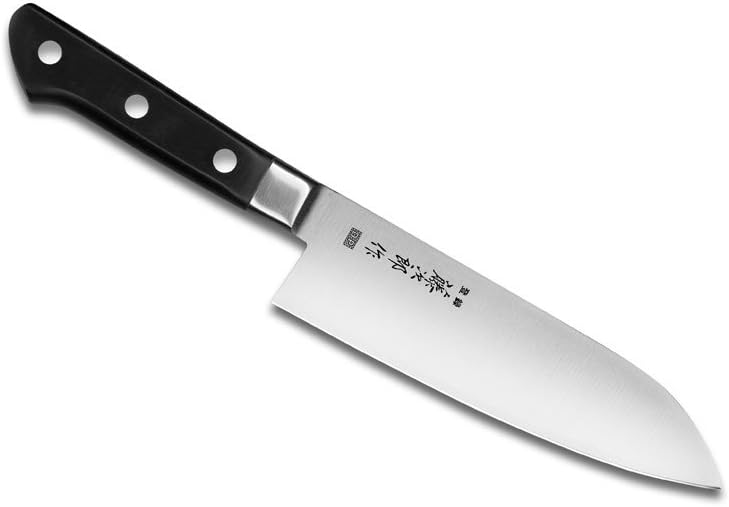
Tojiro DP Santoku 6.7" (170mm)
- SteelVG-10 Core, Stainless Clad
- Hardness~60 HRC
- Price~$123
The best starting point for most home cooks. Made in Tsubame-Sanjo — Japan's knife-making capital — at a price that won't make you afraid to use it daily. Razor-sharp out of the box, balanced, and forgiving enough for beginners. This is what "exceptional value" actually looks like in Japanese steel.
find it here →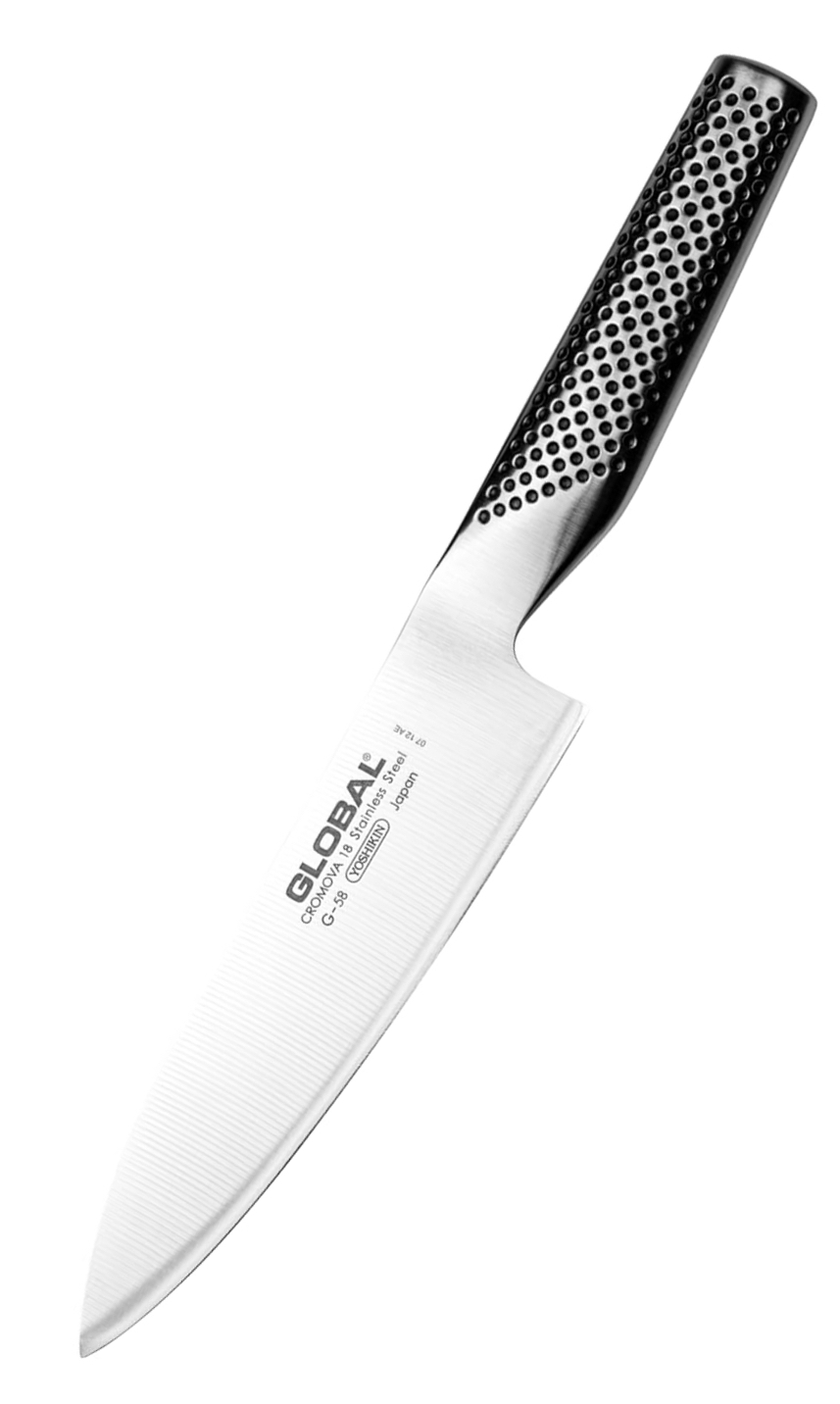
Global G-48 Santoku 7" (180mm)
- SteelCROMOVA 18 Stainless
- Hardness56–58 HRC
- Price~$80
All-stainless construction makes it the easiest Japanese knife to maintain — no handle to worry about, and effortlessly hygienic. Hand-wash recommended to preserve the edge. Slightly softer than VG-10 which means easier to sharpen at home. The right choice if you value low-friction daily ownership over maximum edge retention.
find it here →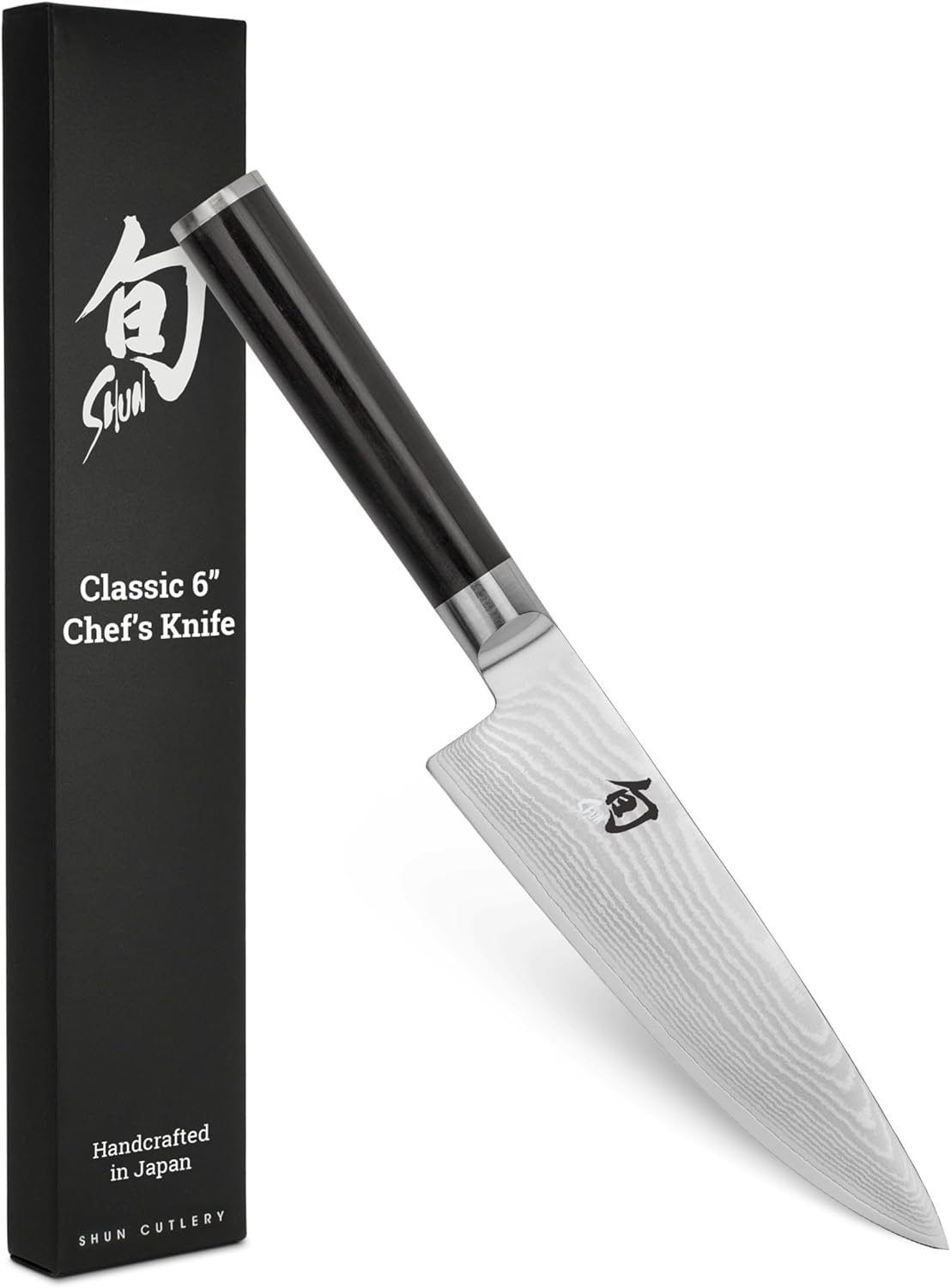
Shun Classic Santoku 7" (180mm)
- SteelVG-MAX Core, Damascus Clad
- Hardness60–61 HRC
- Price~$170
The step-up knife for cooks who want both performance and something genuinely beautiful on the counter. The VG-MAX core holds an edge longer than standard VG-10; the Damascus cladding reduces drag and food sticking. Lifetime warranty. The knife you buy once and pass on.
find it here →The Professional & Specialist Choice
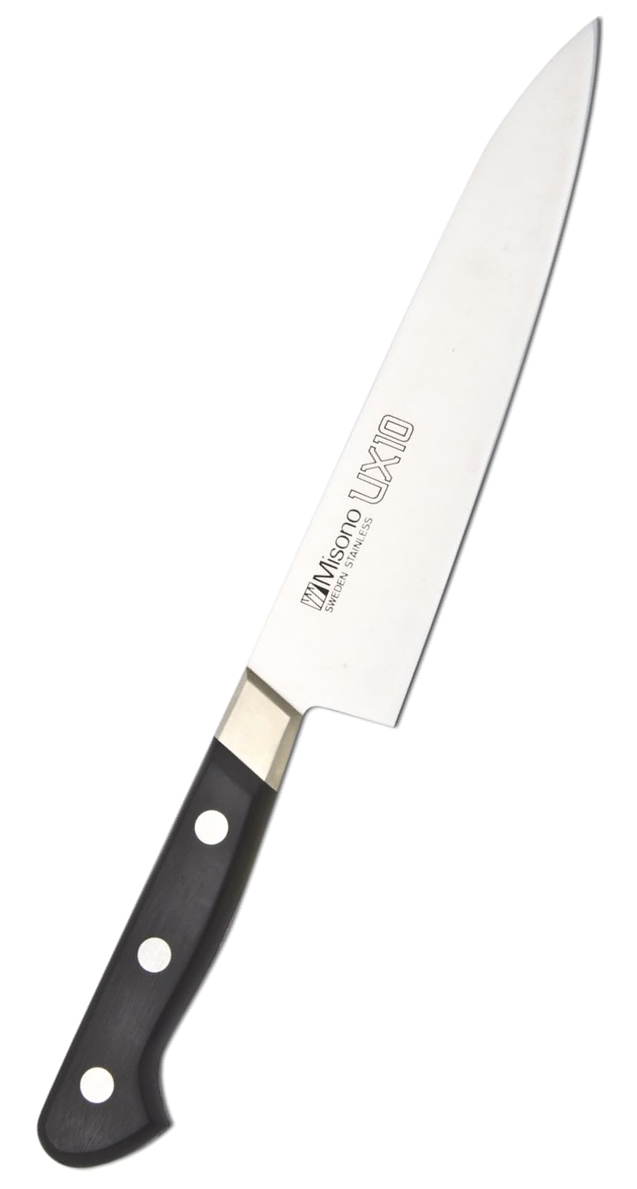
Misono UX10 Gyuto 9.4" (24cm)
- SteelHigh Purity Swedish Stainless
- Hardness59–60 HRC
- Price~$310
The definitive professional workhorse. This 24cm model offers the reach and heft required in high-volume kitchens. Forged in Seki from high-purity Swedish steel, it delivers carbon-like sharpness with total stain resistance and an ergonomic 70/30 bevel.
find it here →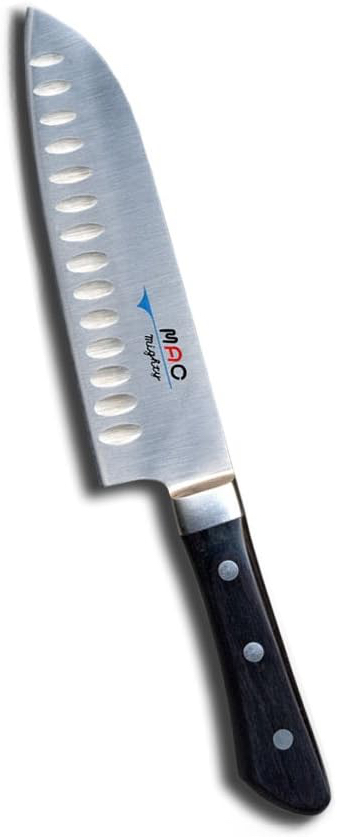
MAC Professional Hollow Edge Santoku 6.5"
- SteelSub-Zero Tempered Molybdenum Steel
- Hardness59–61 HRC
- Price~$130
The "chef's secret." Crafted from sub-zero tempered alloy steel for superior edge retention. The hollow-ground dimples create air pockets, ensuring that even starchy vegetables or delicate proteins slide off the blade with minimal resistance.
find it here →The Bottom Line
For most home cooks: Start with the Tojiro DP Santoku 170mm. Best value in Japanese steel. Use it daily, and within a few weeks you'll understand why Japanese cooks keep the same knife for decades.
If you want iconic design and maximum ease of care: Global G-48. Slightly softer steel, but near-zero maintenance friction.
If you want a heirloom-quality knife you'll never need to replace: Shun Classic. Worth every dollar.
Your second knife: Add a Petty (120–150mm) six months later. That combination handles 99% of home cooking tasks.
As one Kyoto chef observed: "A good knife doesn't make you better overnight. But it removes one barrier between intention and result."