
In This Guide
- 1 The Heritage: Sword vs. Katana Traditions How centuries of meat culture and fish-centric diets shaped the steel in your kitchen today.
- 2 Geometry of the Edge: Physics and Handles From single-bevel physics to handle balance — why these tools feel and cut so differently.
- 3 Material Performance: The Hardness Paradox Navigating the trade-offs of HRC, stainless, and carbon steel for your cooking style.
Note: As an Amazon Associate I earn from qualifying purchases. Prices are approximate and subject to change.
The Heritage: Sword vs. Katana Traditions
To understand why these knives are so different, you need to go back to the forge—not the kitchen forge, but the battlefield.
The European Sword: Designed for Force
Medieval European warfare demanded weapons that could penetrate chainmail and plate armor. The broadsword was double-edged, designed for thrusting and hacking with maximum force. The metallurgical priority was toughness: a blade that could flex on impact without snapping. European smiths produced steel in the 54–58 HRC range—hard enough to hold an edge under battlefield conditions, but soft enough to absorb shock without fracturing.
This philosophy transferred directly to the kitchen. European culinary traditions centered on large land animals—cattle, pigs, boar. Breaking down a side of beef demands the same qualities as combat steel: a blade that survives bone contact, resists chipping under force, and can be re-straightened with a honing rod when the edge rolls. The Western chef's knife rocks forward on a curved blade profile, driving weight downward. Push to cut.
The Katana: Designed for the Perfect Slice
The katana emerged from a completely different tactical requirement. Japanese warriors fought without heavy plate armor. Speed and precision mattered more than brute force. The single-edged blade was designed for one purpose: a single, perfect draw-cut. Japanese smiths developed a differential hardening process—tsuchioki—applying clay to different zones of the blade before quenching, creating a harder edge (hagane) and a softer spine (jigane) in the same piece of steel. The result: an edge harder than anything produced in Europe at the time.
The Forging Divergence: Minutes vs. Days
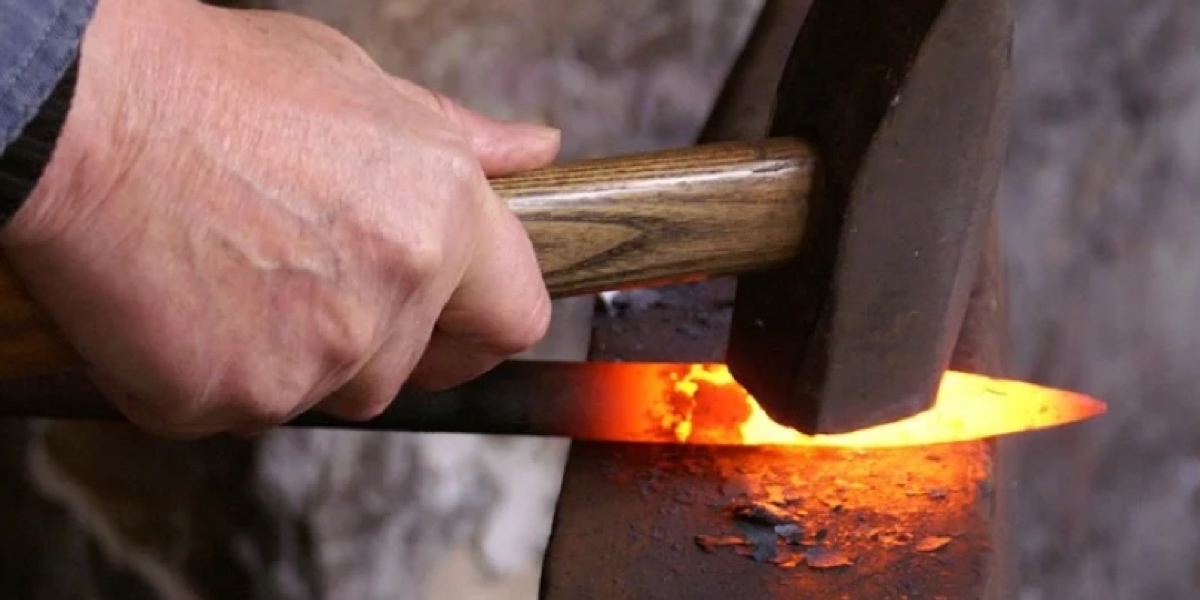
A modern Western stamped knife moves from steel sheet to finished product in minutes. A traditional Japanese knife takes days. Hard steel (hagane) and soft iron (jigane) are heated to 1,000°C, hammered together, folded, and shaped by hand through the tanren process. Precise heat treatment follows—quenching temperatures vary millimeter by millimeter along the blade. The result is a molecular structure that cannot be replicated by machine stamping.
The Culinary Divergence: Meat vs. Fish
Japan's island geography and Buddhist food ethics produced a cuisine built almost entirely around fish, rice, and vegetables. There were no cattle to butcher, no pig carcasses to break down. The kitchen challenge was entirely different: how do you cut raw fish so cleanly that texture is preserved and oxidation is delayed? How do you slice a vegetable so thinly the knife disappears?
This culinary reality drove Japanese smiths to push hardness further than European necessity ever demanded—58–62 HRC for kitchen knives, with some specialized blades exceeding 65 HRC. That hardness enables the acute edge angles that distinguish Japanese knives. It also makes them more brittle. But when your food never includes bone impact, brittleness is a reasonable trade-off for the precision it enables.
The Culinary Philosophy Behind the Steel
Western cuisine: addition. Build flavor through sauces, seasoning, and technique. A slightly crushed tomato disappears into a confit.
Japanese cuisine: subtraction. Reveal the ingredient's inherent quality. A bruised fish cell changes the texture of sashimi, accelerates oxidation, and alters flavor within minutes. The knife isn't a tool—it's the first step in flavor preservation.
⚠️ "Japanese Steel" vs. "Made in Japan" — Know the Difference
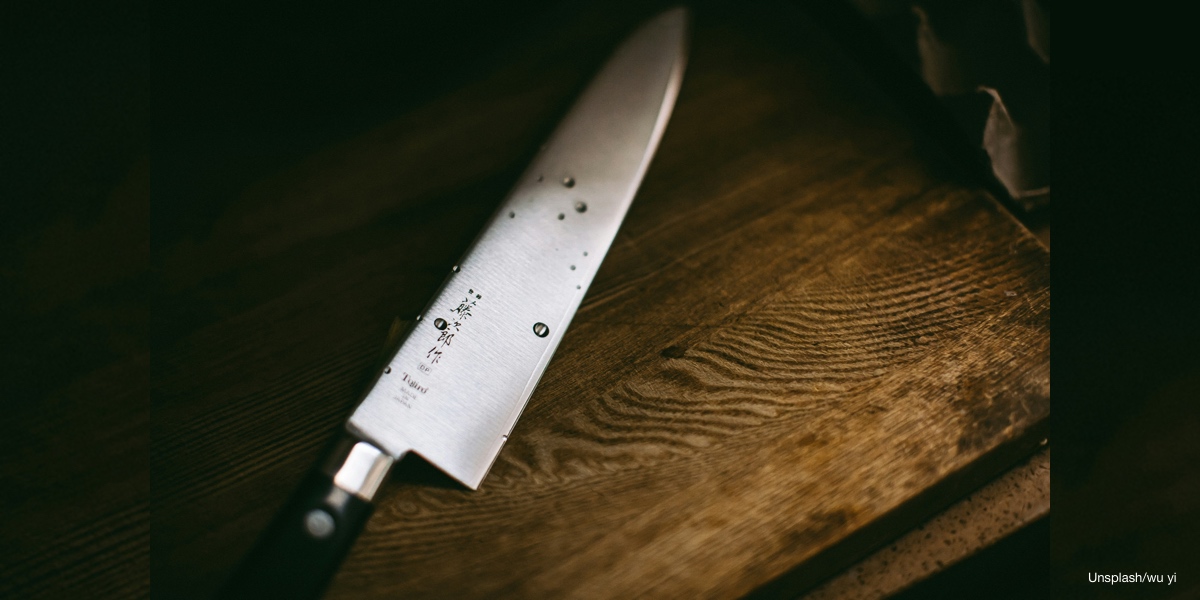
The true value of an authentic Japanese knife lies not in the steel specification alone, but in the heat treatment and forging performed by craftsmen in traditional knife-making regions. Japanese artisans use proprietary quenching techniques to refine the molecular structure of steel to its limit. The same VG-10 specification produces dramatically different results depending on who heat-treats it and how.
Look for: Craftsman's stamp (刻印), production region (産地: Seki 関 or Tsubame-Sanjo 燕三条), and "Made in Japan"—not just "Japanese Steel."
Geometry of the Edge: Physics and Handles
The edge angle is where the historical divergence becomes measurable physics.
Double Bevel: The Western Standard
Western knives are sharpened symmetrically on both sides, producing a V-shaped edge with a total included angle of 40–44° (20–22° per side). When this blade enters food, it creates equal pressure on both sides simultaneously. The food has nowhere to go except compress slightly before splitting. This compression is invisible in most cooking contexts—but under a microscope, cells are being crushed rather than cleanly severed. For robust ingredients cooked with heat and seasoning, it doesn't matter.
Cutting action: Push/rock forward. The curved blade profile allows the rocking chop that defines Western prep technique—efficient for volume work, onion brunoise, mirepoix.
Single Bevel: The Japanese Asymmetry
Traditional Japanese knives are sharpened on one side only. The cutting face is ground to 15–17°; the back is completely flat or very slightly concave (the ura). This asymmetry produces a fundamentally different interaction with food.
When a single-bevel blade enters food, the flat back creates a low-pressure zone on one side of the cut. Food naturally moves away from the blade on that side rather than compressing. The result is a cleaner separation at the cellular level—less compression, less oxidation, less flavor degradation. The flat back also acts as a natural food-release surface: ingredients slide off rather than sticking.
A Japanese study confirmed this with measurable data: tuna cut with a properly sharp single-bevel knife showed higher umami retention and lower bitterness than the same fish cut with a dull or double-bevel blade. Oxidation rate was also measurably slower.
| Feature | Japanese (Single Bevel) | Western (Double Bevel) |
|---|---|---|
| Edge Angle | 15–17° (one side only) | 20–22° per side (40–44° total) |
| Edge Symmetry | Asymmetric — offset to one side | Symmetric — centered |
| Cutting Motion | Draw/pull (like katana) | Push/rock (like broadsword) |
| Food Release | Excellent — concave back creates air gap | Moderate — food sticks to both sides |
| Cellular Impact | Minimal — clean separation | Higher — compression cutting |
| Durability | Chips under lateral force or bone impact | Rolls rather than chips — tolerates abuse |
| Learning Curve | Steep — technique is essential | Gentle — forgiving of imprecise motion |
How the Blade Geometry Shapes the Handle
The structural differences don't stop at the edge—they extend through the entire knife, including the handle.
Western knives use a full tang construction: the steel extends all the way through the handle, visible as rivets on both sides. This adds significant weight to the rear of the knife, shifting the balance point toward the hand. That rear-weighted balance supports the push-and-rock cutting technique: the cook's hand becomes the anchor, and downward force drives the cut.
Traditional Japanese knives use a hidden tang (nakago): a narrow steel extension inserted into a lightweight wooden handle—typically ho wood (magnolia), ebony, or rosewood. The handle is dramatically lighter. This shifts the balance point forward toward the blade, which is exactly what draw-cutting requires. The knife's weight does the work of the cut; the hand simply guides direction with minimal applied force.
The Wa-Handle Philosophy: Replaceable by Design
The traditional Japanese wa-handle (和ハンドル) is not just lighter—it is philosophically different. Because the tang is simply inserted into the handle rather than mechanically fixed with rivets, a worn or damaged handle can be replaced entirely, leaving the blade intact. A well-forged Japanese knife can be re-handled multiple times over decades. This reflects Japan's repair culture (mottainai): nothing is discarded while the essential object still functions. A Western knife with a damaged handle generally means replacement. A Japanese knife with a damaged handle means 20 minutes and a new piece of wood.
The Hybrid Middle Ground
Recognizing that most home cooks want precision without the learning curve of single-bevel technique, Japanese makers developed hybrids with double-bevel edges and Japanese steel and geometry. The Santoku (三徳, "three virtues") handles meat, fish, and vegetables with a flat blade profile and thinner stock than a Western knife. The Gyuto (牛刀, "beef sword") is the Japanese interpretation of the French chef's knife—double-bevel, but sharpened to 17° per side rather than 22°, and considerably lighter. These hybrids dominate modern professional and home kitchens precisely because they split the difference.
Material Performance: The Hardness Paradox
Hardness is the central trade-off of knife steel, and the Japanese-Western divide maps almost perfectly onto opposite ends of it.
Why Japanese Steel Is Harder—and What That Costs
Japanese kitchen knives typically measure 58–62 HRC on the Rockwell hardness scale; premium artisan blades reach 63–66 HRC. Western knives generally fall between 54–58 HRC. This isn't a small difference. On the Rockwell scale, each point represents a significant change in the molecular structure of the steel.
Higher hardness allows a more acute edge angle to be held over time. A 15° edge on 62 HRC steel remains stable under normal use; the same geometry on 56 HRC steel would roll and deform quickly. This is why Japanese knives can achieve and maintain angles that would be impractical in Western metallurgy.
The cost of that hardness is brittleness. Hard steel doesn't bend under lateral stress—it fractures. A Japanese knife that contacts bone, is used to pry, or is drawn across a glass cutting board is at real risk of micro-chipping or edge fracture. Western steel, softer and more ductile, simply rolls the edge under the same treatment—an inconvenience corrected with a honing rod, not a catastrophe requiring a whetstone.
Carbon Steel vs. Stainless: The Other Trade-Off
Carbon steel (traditional Japanese): Allows finer grain structure and a keener edge. Develops a patina that protects against rust over time. Reacts with acidic foods (detectable metallic flavor in citrus). Rusts within minutes if left wet. Preferred by professionals who maintain their knives daily as a discipline.
Stainless steel (modern): 12%+ chromium content prevents rust without patina. Harder to sharpen due to tougher carbides, but modern high-carbon stainless alloys—VG-10, VG-MAX, SG2—largely close the performance gap. The correct choice for most home cooks.
The resolution: Japanese makers created high-carbon stainless alloys specifically to combine carbon's sharpness potential with stainless's rust resistance. VG-10 and SG2 represent this synthesis. They largely succeeded.
| Property | Japanese Steel (58–65 HRC) | Western Steel (54–58 HRC) |
|---|---|---|
| Edge Retention | Excellent — holds acute angles longer | Moderate — dulls faster but easier to restore |
| Sharpening | Whetstone required — honing rods chip the edge | Honing rod effective for regular touch-ups |
| Failure Mode | Chips or fractures under lateral stress | Rolls — correctable without professional help |
| Forgiving Of | Nothing — precision use only | Glass boards, bone contact, occasional neglect |
| Ideal User | Cook who values precision and maintains tools | Cook who values speed and forgiveness |
Our Recommendations
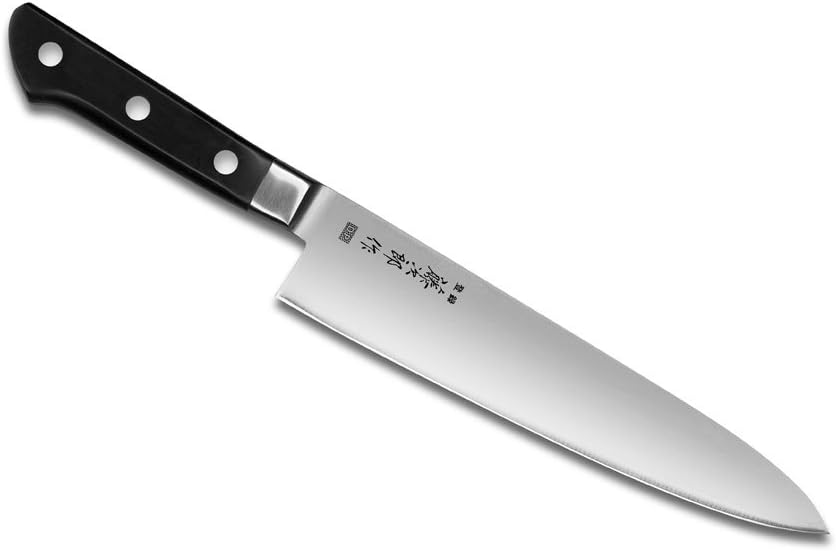
TOJIRO JAPAN Professional Chef Knife 8.2" (210mm)
- SteelVG-10 Cobalt Alloy Core
- Hardness~60 HRC
- Price~$130
The professional's best-kept secret. This 210mm Gyuto provides the familiar weight and profile of a Western chef's knife but with the extreme sharpness of Japanese VG-10 steel. An unbeatable entry point for those transitioning from Western blades.
find it here →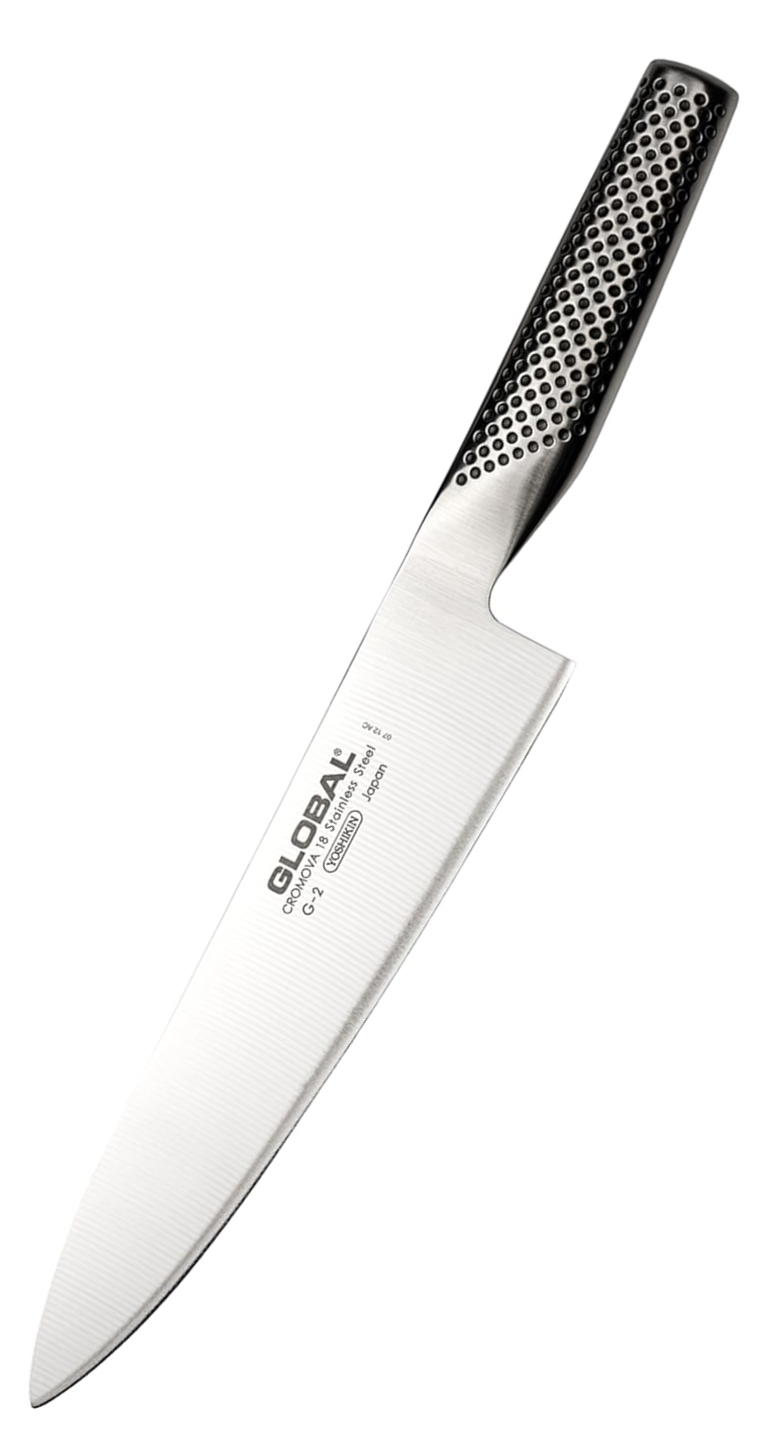
Global G-2 8" (200mm)
- SteelCROMOVA 18 Stainless
- Hardness56–58 HRC
- Price~$150
Iconic, lightweight design. The G-2 is an all-stainless steel masterpiece that offers superb durability and hygiene. Its unique weighted hollow handle ensures a modern, balanced feel that is exceptionally easy to handle for home cooks.
find it here →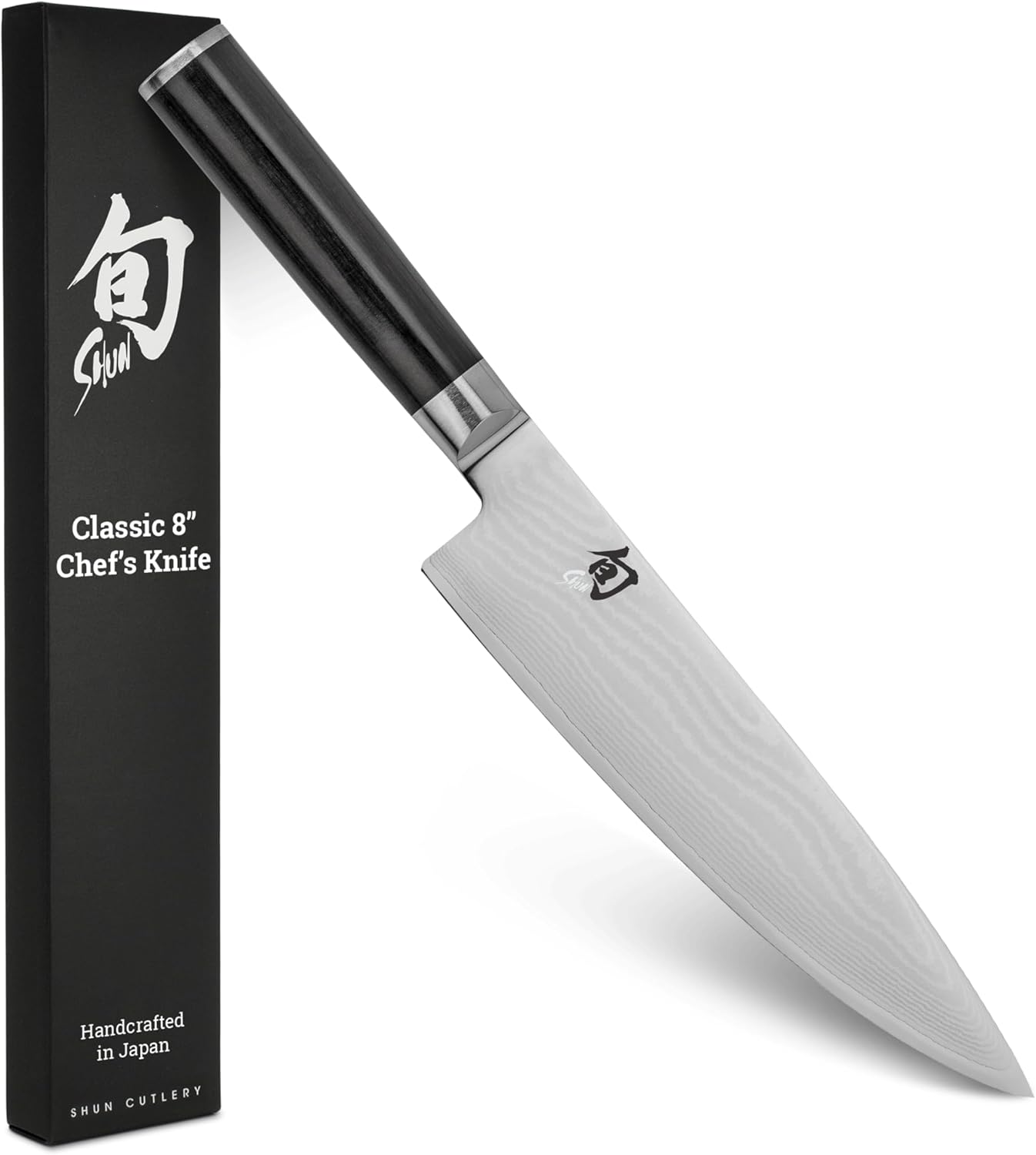
Shun Classic 8" (200mm)
- SteelVG-MAX Damascus Clad
- Hardness60–61 HRC
- Price~$190
Traditional craftsmanship meets modern engineering. Featuring 68 layers of Damascus cladding over a VG-MAX core. Its comfortable D-shaped PakkaWood handle provides the precision and control expected of a high-end Japanese blade.
find it here →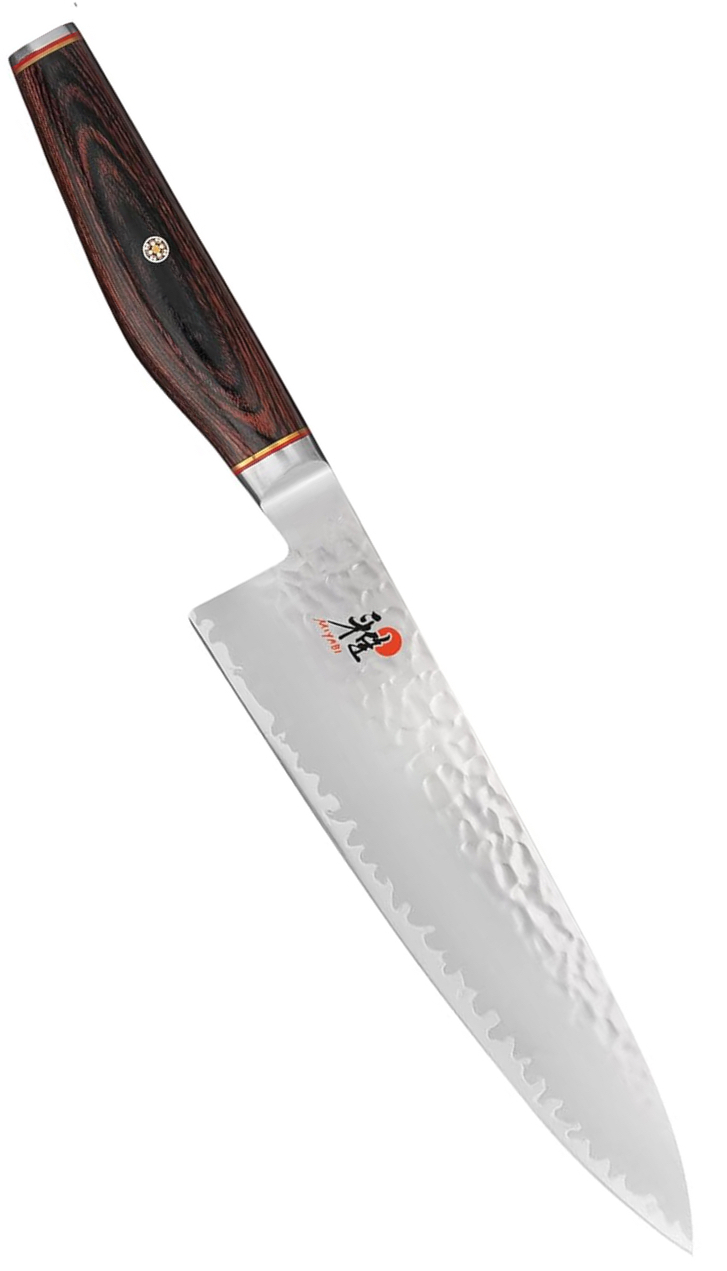
Miyabi Artisan 8" (200mm)
- SteelSG2 Micro-Carbide Powder Steel
- Hardness63 HRC
- Price~$210
The pinnacle of performance and aesthetics. Forged from ultra-hard SG2 powder steel with a stunning hammered "Tsuchime" finish. It delivers unparalleled sharpness and is truly a "buy it once, buy it right" investment for the discerning chef.
find it here →The Professional & Specialist Choice
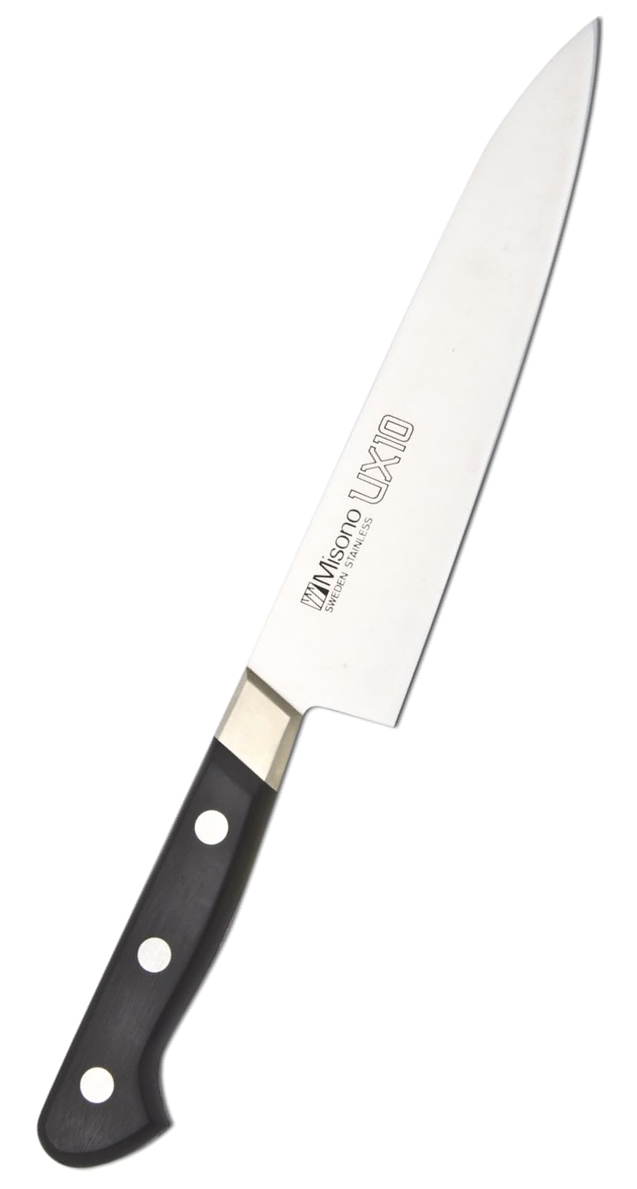
Misono UX10 Gyuto 9.4" (24cm)
- SteelHigh Purity Swedish Stainless
- Hardness59–60 HRC
- Price~$310
The definitive professional workhorse. Handcrafted in Seki using premium Swedish steel, it achieves carbon-like sharpness with total stain resistance. Its asymmetrical 70/30 bevel is specifically engineered for elite culinary precision.
find it here →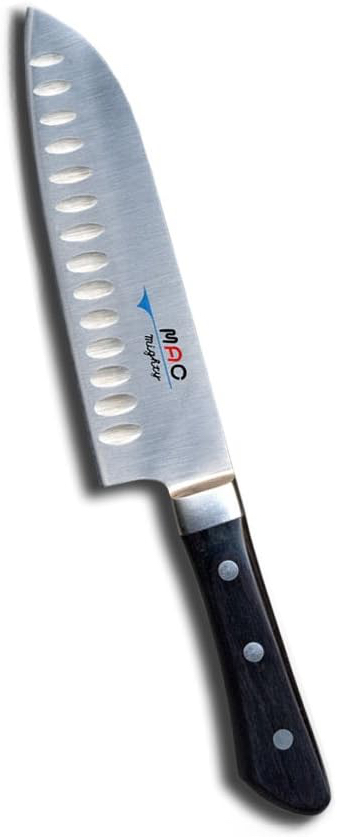
MAC Professional Hollow Edge Santoku 6.5"
- SteelSub-Zero Tempered Alloy Steel
- Hardness59–61 HRC
- Price~$130
A cult favorite among line cooks worldwide. The thin blade and hollow-ground dimples reduce friction, allowing the knife to glide through even the starchiest vegetables. Sub-zero tempering ensures a surgical, long-lasting edge.
find it here →The Bottom Line: Which Philosophy Is Yours?
This comparison isn't about better or worse. It's about alignment between tool and cook.
Choose Japanese steel if you prize precision, cook fish and vegetables, and are willing to maintain your tools with care. The single-bevel yanagiba or a quality Gyuto will change what you think a knife can do.
Choose Western steel if you break down meat regularly, cook under time pressure, and want a knife that forgives the occasional abuse. German steel in the right hands produces excellent food.
Own both. Professional kitchens do. It isn't indecision—it's understanding that different tools serve different purposes, and that mastery means matching the instrument to the task.
Note: This article provides general guidance. Individual knife performance varies by maker, steel specification, and heat treatment. Always follow manufacturer care instructions.