
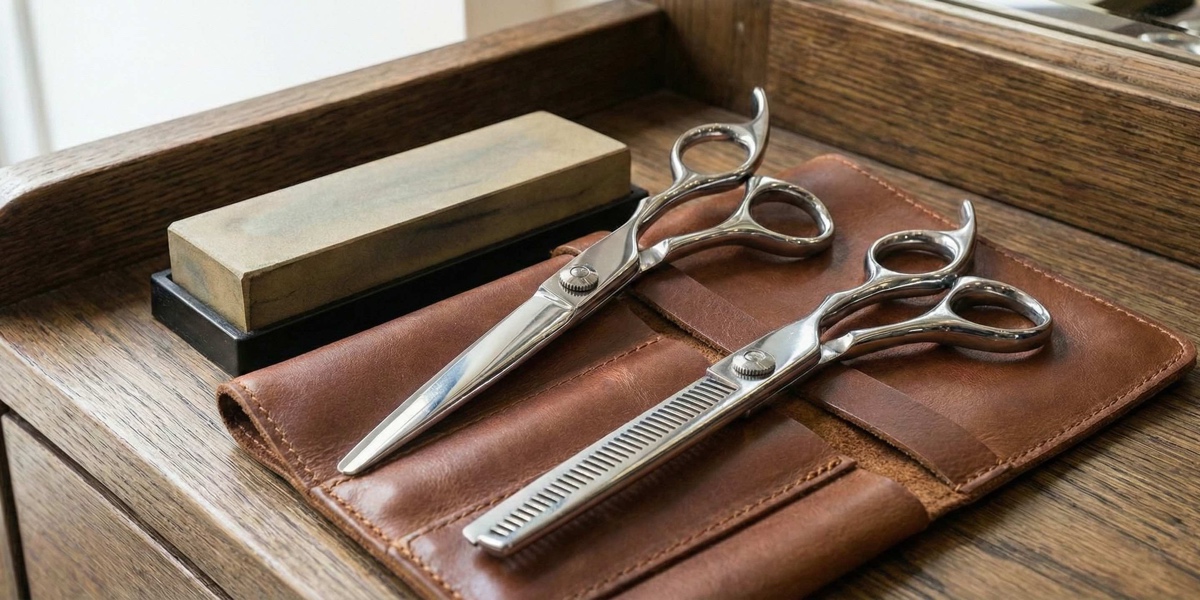
In This Guide
- 1 Why Japanese Scissors Are Different: Steel & Forging How proprietary cobalt alloys and hand-forging produce an edge that lasts years, not months — and the brand story behind it.
- 2 The Convex Edge & the Ergonomics Question The katana-derived geometry that slices instead of crushes — and why handle design is a medical issue for professionals.
- 3 Choosing, Sizing & Keeping Them Sharp The right size for your use, what each price tier actually buys, and why DIY sharpening permanently ruins a convex edge.
Note: As an Amazon Associate I earn from qualifying purchases. Prices are approximate and subject to change.
Why Japanese Scissors Are Different: Steel & Forging
The Steel
Mass-produced scissors use basic stainless steel in the 52–54 HRC hardness range. Functional, but the edge geometry degrades quickly and repeated sharpening eventually hollows the blade beyond recovery. Most cheap scissors are thrown away, not restored.
Japanese professional scissors use proprietary alloy blends developed over decades. Hikari's formula — a trade secret — combines three key additions to base steel:
- Molybdenum: Adds strength and corrosion resistance — the blade maintains structural integrity through tens of thousands of cuts and repeated sterilization cycles
- Cobalt: Increases hardness and edge retention — the sharpened angle holds its geometry under load instead of deforming
- Vanadium: Refines the grain structure at the microscopic level — denser, more uniform steel that resists micro-chipping
The result is 58–62 HRC hardness — sharp enough to sustain an acute convex edge through 50,000+ cuts, calibrated precisely to resist brittleness. This balance requires both the right alloy and the right heat treatment.
⚠️ "Japanese Steel" vs. "Made in Japan" — An Important Distinction
Amazon carries dozens of scissors labeled "Japanese Steel." The steel specification is only part of the equation. Japanese craftsmen control quenching temperatures to within a single degree, balancing hardness and toughness (靭性) in a process that cannot be replicated by factory automation. The same cobalt alloy heat-treated in a Japanese workshop outperforms an overseas-factory equivalent on both sharpness and chip resistance.
Look for: Craftsman's stamp (刻印), production origin — Niigata, Seki, or Tsubame-Sanjo — and "Made in Japan." Not just "Japanese Steel" or "Japanese-style."
Hand-Forged vs. Stamped
Stamped (Mass-Produced)
Process: Cut from flat steel sheet; edges machine-ground
Feel: Thin, light, often flimsy under pressure
Lifespan: 1–3 years of professional use
Cost: $20–100
Hand-Forged (Japanese Professional)
Process: Steel heated and hammered into shape; hand-finished by craftsmen
Feel: Substantial, balanced, controlled at low grip pressure
Lifespan: 10–20+ years with proper professional sharpening
Cost: $200–1,500+
Forging compresses the steel's molecular structure in ways that stamping cannot. Hand-finishing ensures blade angle, edge alignment, and pivot tension are set precisely — variables that automated production cannot replicate at the tolerances professional scissors require.
The Hikari Story
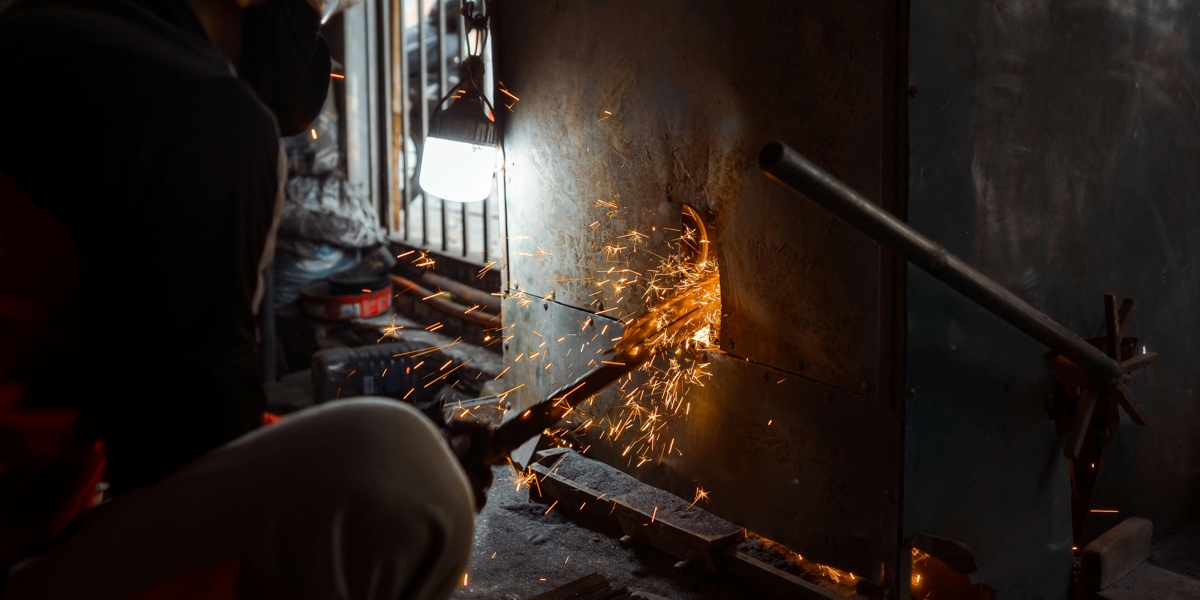
In 1968, Fukataro Takahashi — a world champion hairdresser — couldn't find scissors that met his own standards. So he built a factory in Niigata and made them himself.
Three generations later, the company is still run by professional stylists: his son (also an award-winning stylist) took over, then passed it to his son. Hikari is the only scissors company founded by — and still run by — people who cut hair for a living.
Most scissors manufacturers outsource production and apply their logo to mass-produced shears. Hikari controls every step in-house: alloy formulation, forging, hand-finishing, quality control, and lifetime aftercare. The design decisions are made by people who use scissors daily. Not by engineers who haven't.
The Convex Edge & the Ergonomics Question
The Convex Edge: Katana Geometry Applied to Hair
The defining feature of a Japanese professional scissor is its edge geometry. The convex edge (ハマグリ刃, hamaguri-ba — literally "clam shell edge") is borrowed directly from katana sword-making.
A conventional beveled edge is ground flat on one or both sides, creating a V-profile. When this blade contacts hair, it creates equal compressive force on both sides of each strand. The hair has nowhere to go except compress and split. This is the mechanism behind split ends, frayed texture, and the ragged finish that cheap scissors produce — it's not just that they're dull, it's that the geometry crushes rather than cuts.
A convex edge is ground with an outward curve on the cutting face. When this geometry enters hair, the curved face guides the strand away from the blade rather than compressing it against it. The result is a true slice — clean separation with minimal lateral force.
Why Convex Edges Can't Be Machine-Ground
The hamaguri curve must be maintained to tolerances measured in fractions of a millimeter. Too flat and the slicing advantage disappears; too steep and the edge becomes fragile. A skilled artisan grinds wet, by hand, reading the steel's response to adjust pressure in real time.
Machine-ground "convex" edges — common on imitation products — are approximations that can't replicate this curve. They function like beveled edges and crush hair the same way. After Hikari introduced the convex edge, every premium brand tried to copy it. As Hikari puts it: "Although the form could be reproduced, the quality of sharpness cannot be duplicated."
For home use: Even for monthly cuts on one or two people, the difference is visible. Split ends begin at the cutting surface. A convex-edge cut seals the hair cortex; a beveled crush leaves it open and fraying within days.
Ergonomics: Why Handle Design Is a Medical Issue
Professional stylists open and close scissors 5,000–10,000 times per day. At that volume, handle geometry is an occupational health question. Repetitive strain injury and tendonitis are among the most common career-ending conditions in hairdressing — and the handle is the primary variable a stylist can control.
Why cheap scissors cause injury:
- Symmetrical handles force the thumb to work against its natural range of motion
- Dull blades require excessive squeezing force — hand compensates with extra effort
- Poor balance means the wrist makes constant micro-adjustments
- Wrong finger hole size locks the hand into an awkward position for hours
How Japanese scissors solve this:
- Offset handles: Thumb ring sits lower than the finger ring — the hand rests in its natural relaxed position, no pronation required
- Swivel thumb rings: Thumb rotates freely during the cutting motion, keeping the wrist neutral and eliminating the repetitive twist that drives tendon inflammation
- Adjustable tension: Each stylist calibrates blade resistance to their grip strength — prevents overgripping when scissors are too loose or too stiff
- Perfect balance: Weight distributed so the scissor rests in equilibrium at the pivot — minimal grip tension needed to maintain control
Hikari's Five-Finger Ergonomic Design
Some Hikari models (Phoenix and Cosmos series) use a "five-finger ergonomic positioner" — a handle geometry that distributes effort across all five fingers rather than concentrating it in the thumb and ring finger. The weight is balanced so the scissor sits at equilibrium at the pivot point.
Platform artists and educators who use scissors continuously for 8+ hour training days report this design as the primary reason they can maintain their schedule without chronic hand pain. For home users cutting monthly, the benefit is comfort — but the underlying mechanism is the same.
Choosing, Sizing & Keeping Them Sharp
Choosing the Right Size
Professional scissors are sold in half-inch increments because the blade length determines the cutting arc, and the cutting arc determines which techniques are comfortable:
- 4.5"–5": Detail and precision work — around ears, close-cropped cuts, barber-style finishing
- 5.5": The industry standard. Most versatile — works for all standard techniques, right for most home users
- 6": Long hair, blunt cuts, wet cutting where longer draw strokes are needed
- 6.5"–7": Specialized for very long hair, extensions, or stylists with large hands
Hand size matters as much as technique. Small hands in 6.5" scissors lose control on detail work. Large hands in a 4.5" scissor cramp within minutes. When in doubt, start with 5.5".
The Price Spectrum: What Each Tier Buys
| Price Range | What You Get | Best For |
|---|---|---|
| $50–150 | Entry-level Japanese or semi-professional Western. Decent steel, basic convex or beveled edge. | Beauty school students, home haircuts, occasional use |
| $200–400 | Mid-tier Japanese (Hikari EON, entry Mizutani). Good alloy steel, hand-finished convex edge. | New professionals, stylists cutting 5–15 clients/day |
| $500–800 | Premium Japanese (Hikari Epic/Beam/Phoenix). Proprietary alloy, full ergonomic design, lifetime-grade quality. | Established stylists, high-volume salons, platform artists |
| $900–1,500+ | Top-tier handmade (Hikari New Cosmos, Mizutani Acro, custom orders). Ultimate sharpness, custom fit. | Master stylists, celebrity hairdressers, collectors |
The Investment Case
A professional stylist cutting 10 clients per day, 250 days per year, over 10 years completes roughly 25,000 haircuts. A $1,000 scissor costs $0.04 per haircut. A $100 scissor that lasts 1,000 cuts costs $0.10 per haircut — plus sharpening costs, plus the cumulative ergonomic cost of using an inferior tool for a decade. Quality isn't a luxury. It's a lower operating cost with less occupational risk.
Thinning Shears: The Second Essential Tool
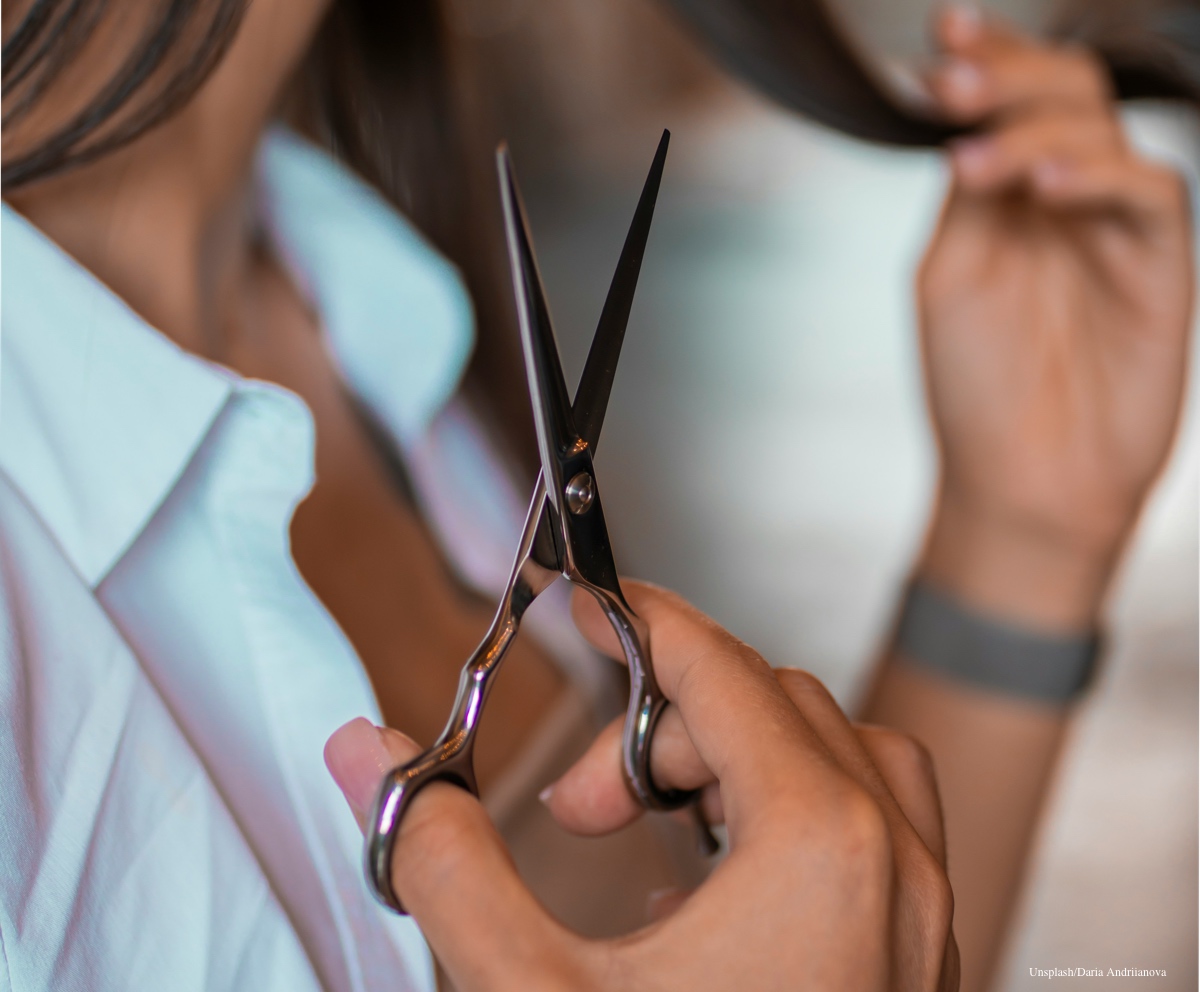
Most professionals own two scissors: one cutting shear (5.5") and one thinning shear (5.5" or 6"). Thinning shears carry teeth on one blade that remove bulk without altering length.
Tooth count determines aggressiveness: 15-tooth removes bulk quickly, 25-tooth produces moderate thinning, 35-tooth provides subtle texturizing without visible reduction. For home users, 25- or 30-tooth is typically the right balance. The quality difference mirrors cutting shears — cheap thinning shears have unevenly spaced teeth that tear rather than cut, while Japanese versions machine each tooth to exact alignment with a convex edge at every tip.
Professional Care: The Sharpening Question
Sharpening intervals depend on use:
- Heavy professional use (20+ cuts/day): Every 6–9 months
- Moderate professional use (10–15 clients/day): Once a year
- Home use (monthly cuts): Every 2–3 years
Why DIY Sharpening Destroys a Convex Edge
The hamaguri curve requires the same trained judgment that created it. Consumer sharpening tools, pull-through sharpeners, and general-purpose sharpening services grind convex edges flat. A single pass with an inappropriate sharpener permanently converts the geometry from convex to beveled. The $600 scissor is now worth $40, and the damage cannot be undone.
Always use: A manufacturer-certified sharpener, or return scissors directly to the manufacturer. Many premium Japanese scissors — including Hikari's upper tiers — include lifetime factory sharpening as part of the purchase.
Daily care (30 seconds):
- Wipe blades with a soft cloth after each use
- Oil the pivot screw weekly with mineral oil — never WD-40, which strips the lubrication
- Store in the protective case — never loose in a drawer where tips can contact other objects
- Never drop them — even once can shift the blade alignment enough to affect the cut
The Bottom Line
Japanese professional scissors aren't expensive because of branding. They cost what they cost because of what they require to produce: proprietary alloys, traditional forging, hand-finishing by craftsmen, and ergonomic engineering refined over decades of professional feedback.
For home cuts once or twice a month: A $200–300 mid-tier Japanese scissor is a rational investment. It will last years without resharpening, cut cleanly every time, and fit comfortably in any hand.
For professionals cutting 10+ clients daily: The $500+ tier is where the tool stops being a liability and becomes an asset — protecting both the quality of your work and the health of your hands.
Our Recommendations
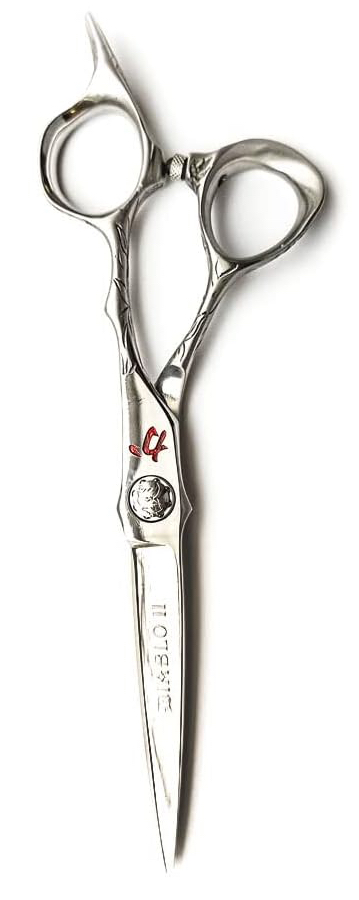
Kamisori Diablo II (5.5"/6.0")
- Price~$290
- SteelTakefu Cobalt, Japan
- EdgeConvex, Hand-Finished
- Best ForHome & Light Professional
The best entry point into genuine Japanese convex-edge scissors. Takefu Cobalt steel delivers noticeably better edge retention than basic stainless — clean cuts for years before needing sharpening. Versatile enough for home use, sharp enough for light salon work. The most accessible way to understand what the difference actually feels like.
find it here →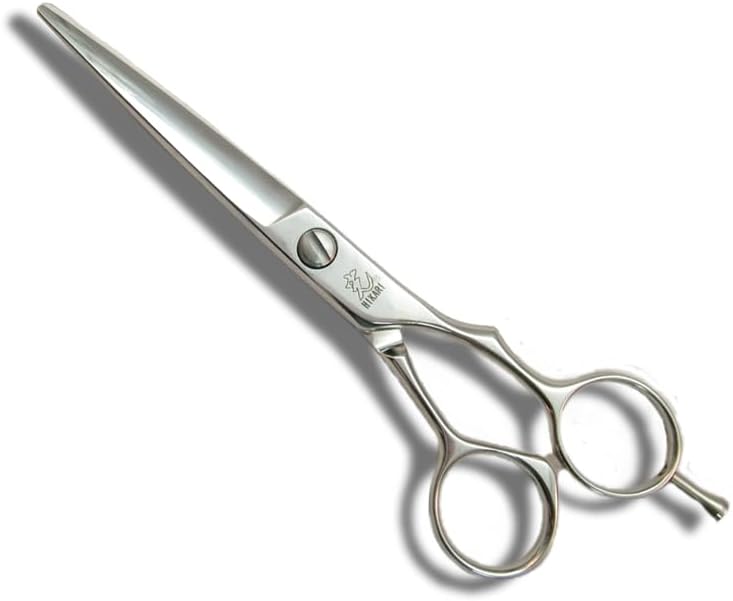
Hikari EON Series (5.5")
- Price~$425
- SteelHikari Cobalt Alloy, Japan
- EdgePrecision Convex (Hamaguri-ba)
- Best ForSerious Home & New Professionals
Hikari's entry into their proprietary cobalt alloy range — the first level where you experience the full hamaguri-ba geometry as Fukataro Takahashi intended it. Offset handle, adjustable tension, hand-finished edge. The difference versus a $100 scissor is immediately obvious in both the cut quality and how your hand feels after an hour.
find it here →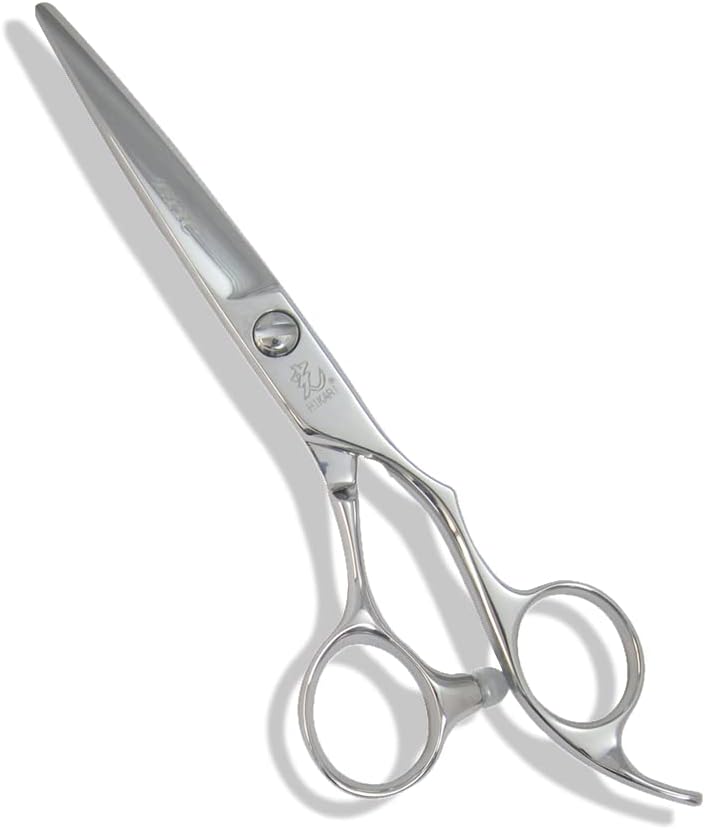
Hikari Epic Series (5.5")
- Price~$665
- SteelHikari Premium Alloy, Japan
- EdgePrecision Convex, 3D Offset Handle
- Best ForHigh-Volume Professionals
The full Hikari ergonomic system: 3D-offset handle, swivel thumb ring, five-finger weight distribution — designed for stylists cutting 10+ clients a day who cannot afford hand fatigue. The premium alloy holds its edge measurably longer than the EON tier. Platform artists and educators reach for the Epic series specifically because it performs across an 8-hour day without the hand starting to protest.
find it here →