
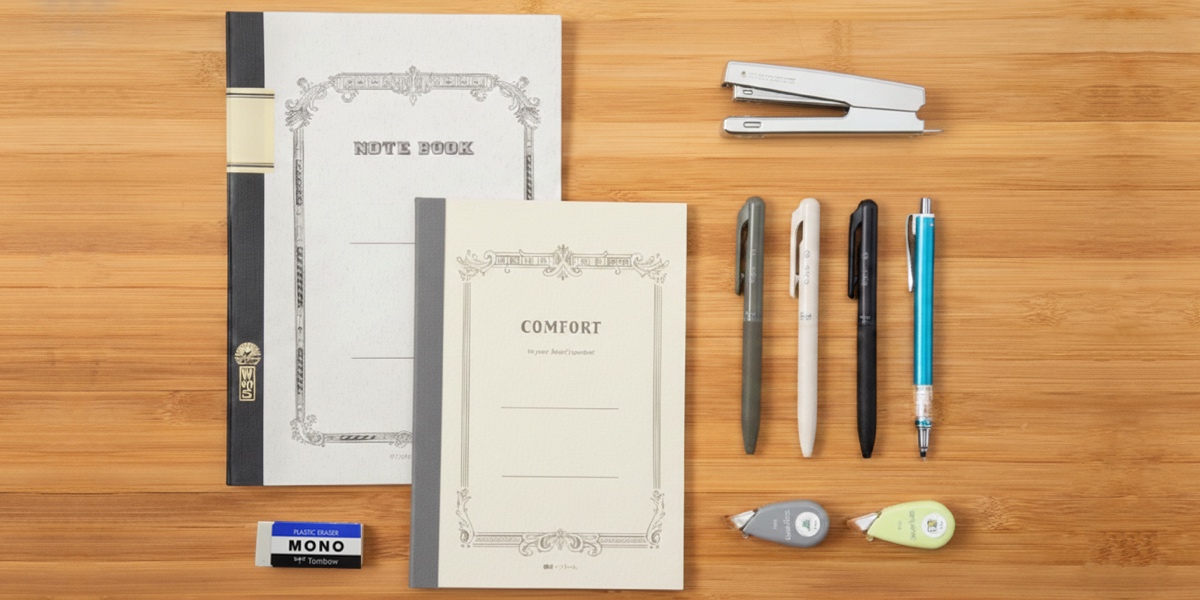
The quality is unmatched, yet the prices remain incredibly reasonable. While a $5.00 Western pen might feel like a standard tool, a $1.50 to $2.00 Japanese gel pen often outperforms it. Once you experience the precision and "skating on ice" glide of Japanese stationery, going back to Western brands feels like a total downgrade. This is the result of over 40 years of engineering obsession and hundreds of design iterations.
In This Guide
Note: As an Amazon Associate I earn from qualifying purchases. Prices are approximate and subject to change.
The Engineering of the Point: Precision You Can Feel
The tip of a pen is its most mechanically complex component. The clearance between the ball and socket is machined to micrometre tolerances to control ink flow, line width, and feedback.
The Needle-Point Advantage
Most Western pens use a "conical tip," where the ball is seated in a cone-shaped housing that can block your sightline. However, many iconic Japanese pens, like the Pilot Hi-Tec-C, use a "needle-point tip".
Structural comparison: The needle-point's three-point ball support (left) exposes the writing tip fully and dampens paper feedback. The conical housing (right) encloses the ball on all sides, restricting visibility and setting a lower floor on external diameter.
- Better Visibility: A thin metal tube supports the ball from three contact points, removing visual obstruction so you can see exactly where you are writing.
- Smoother Glide: This architecture dampens vibrations from the paper, producing a smoother tactile experience even at ultra-fine sizes.
- Ultra-Fine Lines: Needle-point engineering makes 0.25mm and 0.3mm tips mechanically viable, diameters that are nearly impossible to achieve reliably with a standard conical housing.
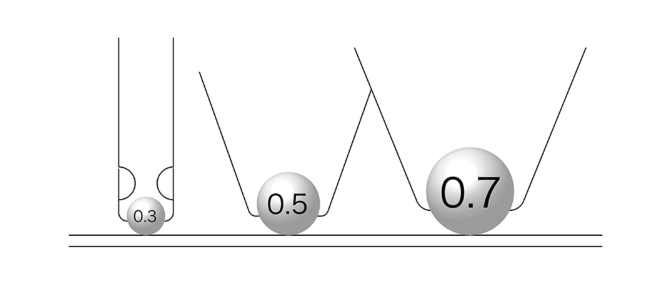
The 0.5mm Paradox
A Japanese pen labeled "0.5mm" and a Western pen labeled "0.5mm" do not produce the same line.
- Japanese Convention: Manufacturers measure the exact ball diameter. Because the ink and socket are engineered to minimize lateral spread, the line stays true to that size.
- Western Convention: Manufacturers specify an approximate line width that accounts for ink spreading. A Western 0.5mm ball often produces a line closer to 0.7mm.
Pro Tip: If you love a Western 0.7mm, a Japanese 0.5mm will likely feel like the perfect equivalent.
Specialized Ink Chemistry: Formulas for Real Life
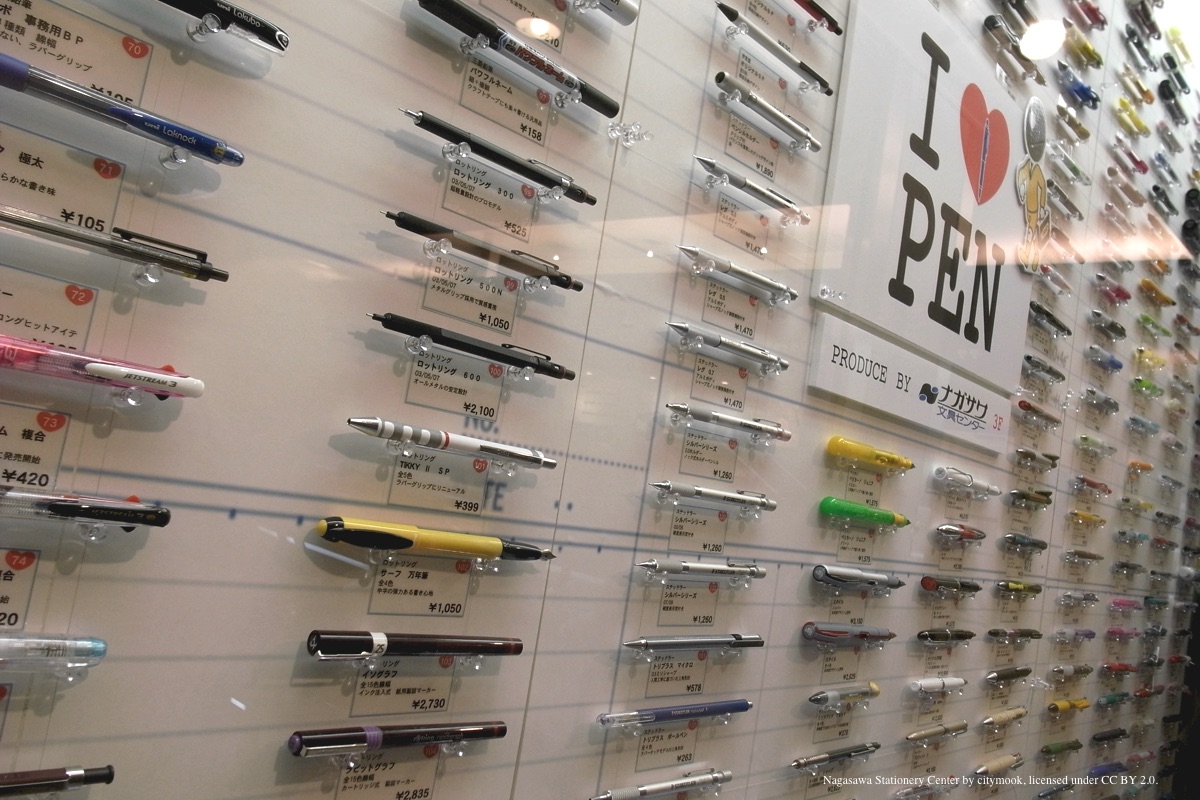
Japanese manufacturers offer distinct ink architectures optimized for specific daily problems rather than settling for a one-size-fits-all approach.
- For Lefties (The 0.5-Second Rule): Left-handed writers often smudge ink as their hand moves across the page. Zebra Sarasa Dry uses a formula that sets in just 0.5 seconds—nearly ten times faster than standard gel ink.
- Highlighter-Proof: Most gel inks smear when you highlight over them. Zebra Sarasa Mark-On uses a polymer system that creates stronger adhesion to paper fibers, becoming resistant to highlighters in just 5 seconds.]
- Archival Standards: For legal documents or journals meant to last decades, the Uni-ball Signo series uses pigment-based "Super Ink" that binds to paper at a molecular level, resisting water, UV light, and even chemical tampering.
- The Erasable Miracle: Pilot FriXion uses thermochromic ink that becomes invisible when the friction from the eraser generates heat at approximately 60°C.
The "Mottainai" Philosophy: A Unique Refill Culture
While Western luxury brands have offered refills for decades, Japan has revolutionized the concept by bringing it to the mass market.This is driven by the philosophy of mottainai (もったいない)—the sense of regret at wasting something that still has value.
Mass-Market Accessibility
Unlike the West, where refills are often reserved for expensive pens, Japan provides high-quality refills for their affordable $1.60 daily-use pens.
Economic Incentive
A pen body costs about $1.60, while a refill is only about $0.80. This makes the eco-friendly choice the most economical one.
Paper Synergy
While these pens will significantly upgrade your experience on any standard notebook , their true 'HD' performance is unlocked on high-density surfaces. Because many Western papers are more absorbent, they can cause fine gel lines to spread slightly. To avoid this and see the engineering at its best, try pairing your pen with a smoother surface like a Kokuyo Campus notebook (~$5.00)—it’s essentially co-engineered to keep those ultra-fine lines perfectly crisp
Our Recommendations
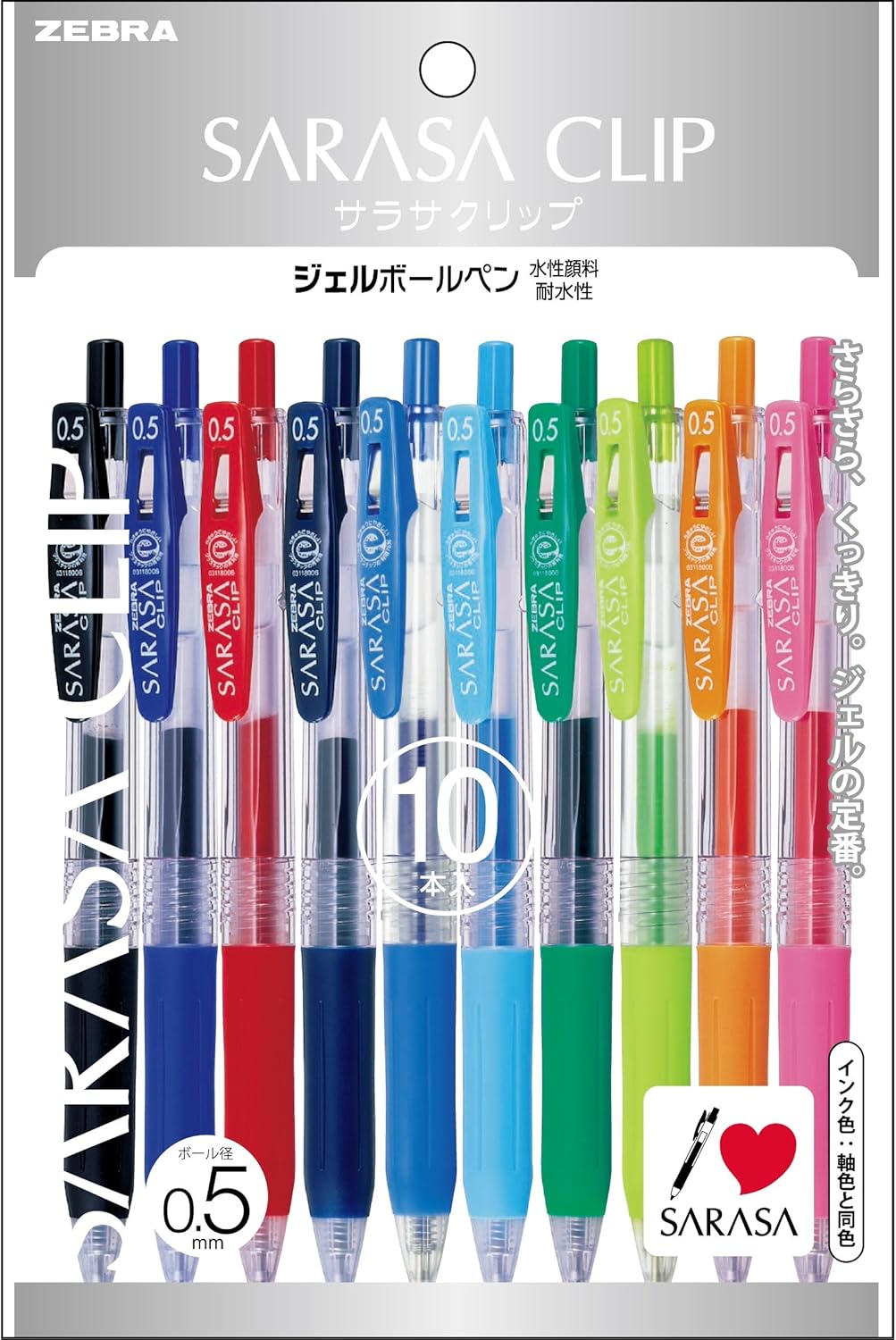
Zebra Sarasa Push Clip
~$8 (5-pack)
- Tip0.5mm Gel
- InkWater-Resistant Gel
- Best ForEveryday Note-Taking
- RefillableYes — Universal Sarasa Refill
The definitive entry point. Smooth, consistent 0.5mm gel performance with a clip mechanism robust enough for daily pocket use. The ink is water-resistant once dry and compatible with most highlighters. Start here.
find it here →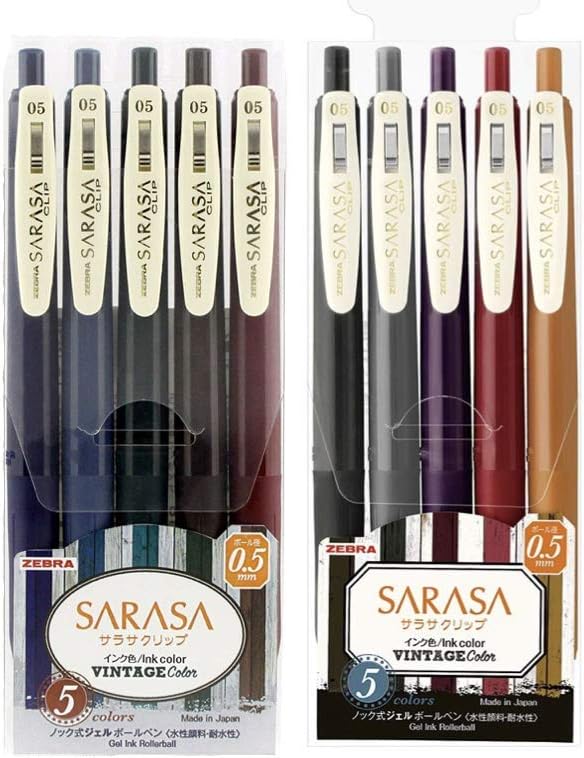
Zebra Sarasa Clip — Vintage Colors
~$12 (5-pack)
- Tip0.5mm Gel
- InkMuted Pigment Gel
- Best ForJournaling & Annotation
- RefillableYes — Universal Sarasa Refill
The same Sarasa mechanism and ink platform, reformulated in a curated palette of muted tones — dusty rose, slate, antique blue — that produce legible, visually calm annotation. The colour saturation is deliberately lower than standard Sarasa; the writing performance is identical.
find it here →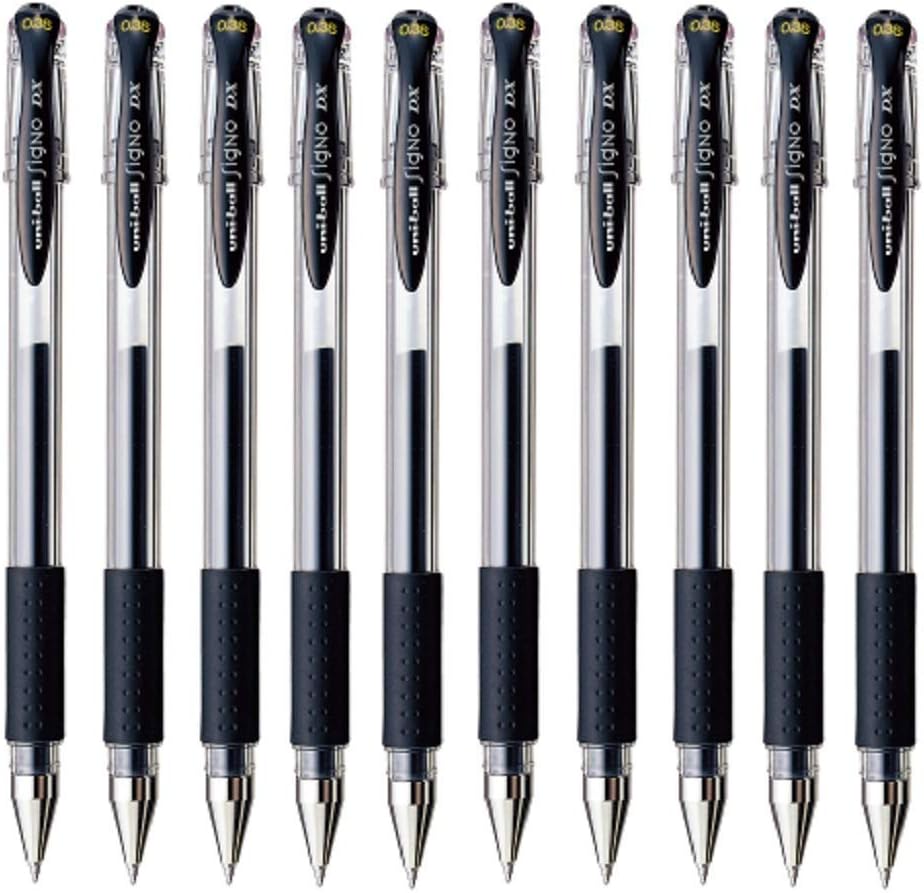
Uni-ball Signo RT1
~$10 (5-pack)
- Tip0.38mm Gel
- InkPigment-Based (Fade & Water Resistant)
- Best ForLegal Documents & Archives
- RefillableYes
The archival standard. Super Ink technology produces a line that resists water, UV, and chemical tampering. At 0.38mm, the tip sits between fine and ultra-fine — precise enough for dense notes, fast enough for continuous writing without the deliberate pace required by 0.3mm tips. The retractable mechanism eliminates cap loss.
find it here →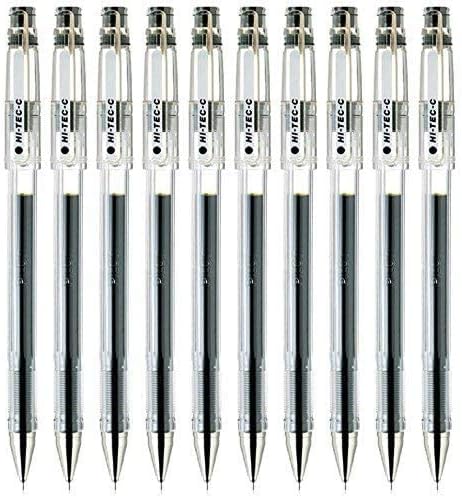
Pilot Hi-Tec-C
~$9 (3-pack)
- Tip0.4mm Needle-Point
- InkControlled-Flow Gel
- Best ForPlanners, Diagrams, Small Handwriting
- RefillableYes — Hi-Tec-C Refill System
The canonical needle-point pen. Thirty years of continuous production, unchanged in its fundamental architecture. The 0.4mm version balances maximum fineness with reliable ink flow for most writing conditions. Available in 0.25mm, 0.3mm, 0.4mm, and 0.5mm — the 0.4mm is the recommended entry to the range.
find it here →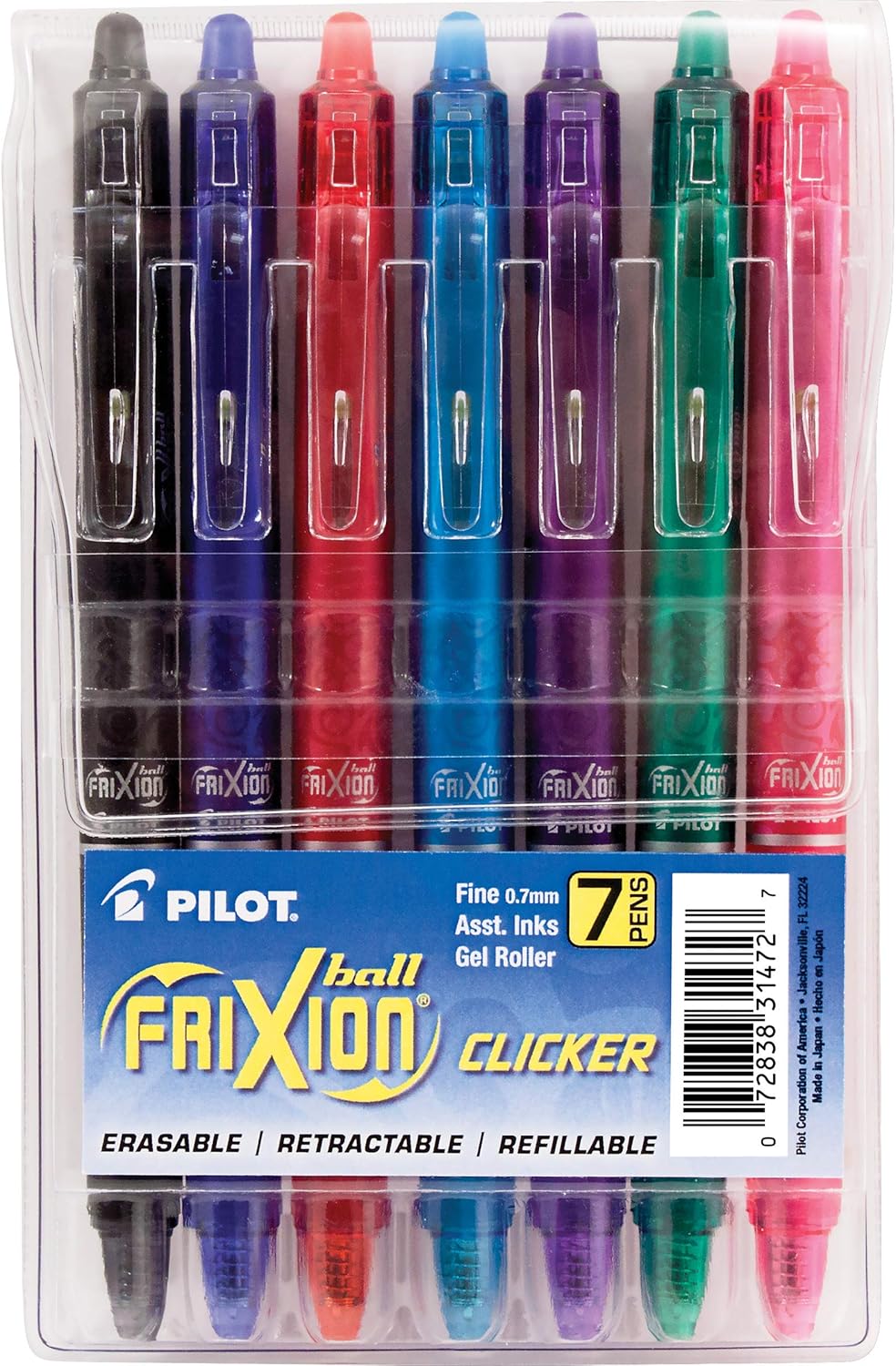
Pilot FriXion Clicker
~$15 (3-pack)
- Tip0.7mm Thermochromic Gel
- InkLeuco Dye — Erasable, Not Permanent
- Best ForDrafting, Planning, Revision Workflows
- ArchivalNo — Not for Legal or Permanent Documents
Erasure by friction-generated heat rather than abrasion. The gel writing experience is equivalent to standard Pilot gel; the erasability is achieved by the thermochromic compound in the ink, not by the eraser removing material. Full revision capability at full gel performance. Not suitable for any document requiring permanence.
find it here →The Bottom Line
Japanese pens are better because Japan treats writing as an engineering problem. The needle-point tip, the thermally-stable ink, the mottainai-driven refill system — none of these features exist because they are easy to manufacture. They exist because specific failures were identified, studied, and resolved through precise iteration over decades. The result is an instrument that costs less than a coffee and performs like a precision tool.
Start with: Zebra Sarasa Clip — smooth, reliable, refillable ($8 / 5-pack).
If you write small: Pilot Hi-Tec-C 0.3mm or 0.4mm ($9 / 3-pack).
If you need permanent ink: Uni-ball Signo RT1 ($10 / 5-pack).
If you need to revise: Pilot FriXion Clicker — not for anything permanent ($15 / 3-pack).
If you journal: Zebra Sarasa Vintage — all the performance, quieter on the page ($12 / 5-pack).